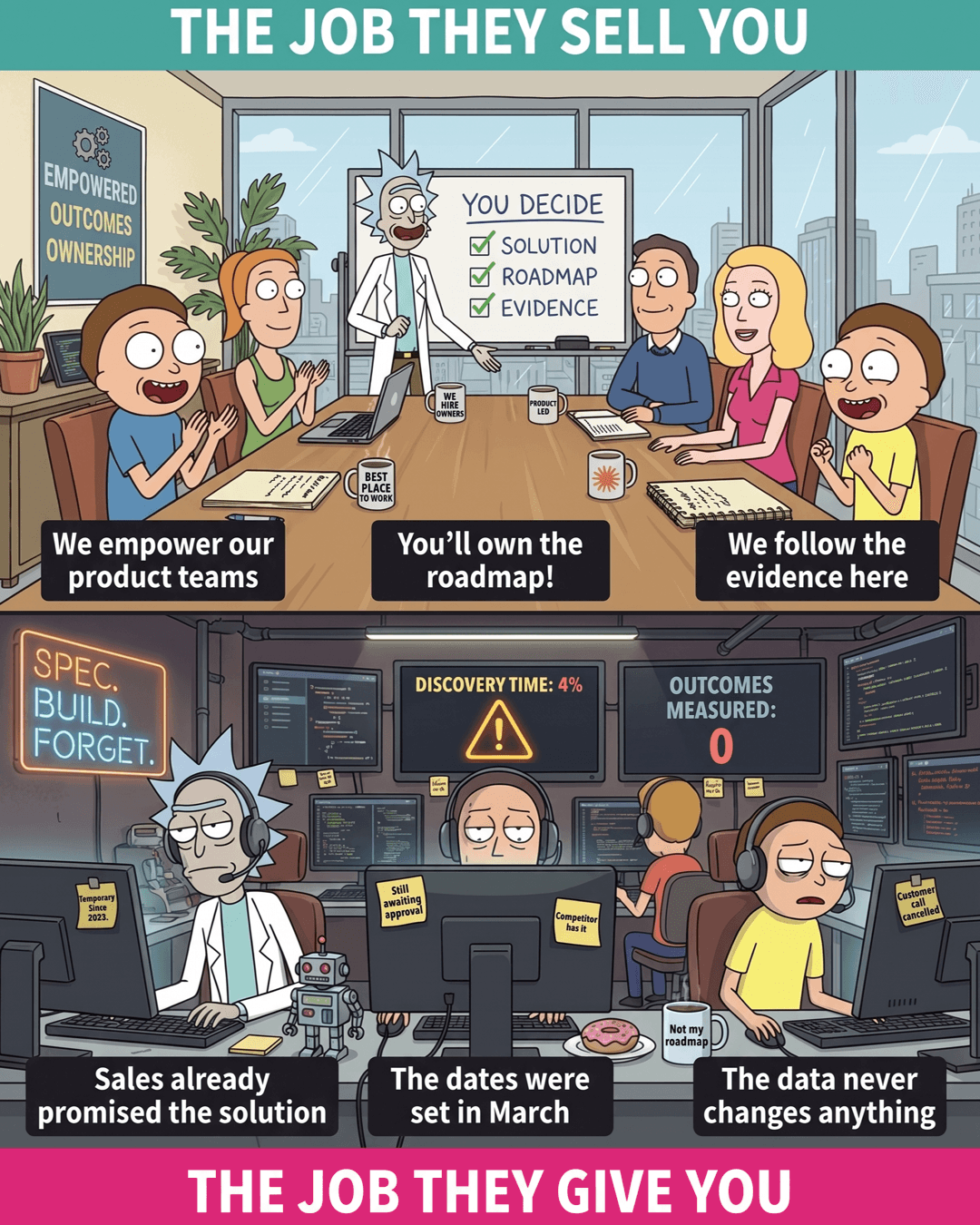
Same interview. Three years. Two completely different careers.
Two product companies can run the same pitch. Empowered teams, outcomes, ownership. You'll own the roadmap. We follow the evidence here. Only one of them can back it up, and from the outside they look identical. Except in one room: the interview.
One question, asked before you sign, tells you which job you are actually being offered.
Ask for an event, not a principle
The people who get this right don't ask about empowerment. Ask about empowerment and you'll get a description of the culture the company wants to have. Instead, they ask for a single event.
The question is this: "When did evidence last change something the company had already decided?"
Then test it across three situations. A solution Sales had already promised. A roadmap item that was already approved. A date already given to a customer. For each answer, ask who made the decision, what the trade-off was and what happened next.
Each situation tests something different. A solution Sales already promised shows whether product can push back on a commercial commitment. An approved roadmap item shows whether approval means the thinking stops. A date already given to a customer shows whether the company will move an external promise when the evidence says it should. A team can be flexible on one and rigid on the other two, so ask about all three.
The reason this works is simple. Changing course costs a company something real. Teams that do it can name the cost. Teams that don't will answer you with a principle.
When you get a principle, ask again
When the answer comes back as a value statement, ask again, warmly. "That makes sense. What's a recent example?"
Then ask a future peer the same thing. The hiring manager tells you how decisions are meant to work. The person who'll sit next to you answers it differently, because they live with how decisions actually get made.
This doesn't make you look difficult. Asking how decisions get made is the job you're interviewing for.
And if nobody can name one event, that's your answer. Empowerment is the plan there, not the job.
Why the answer matters more now
The illustration with this piece shows the gap. The top half is the job they sell you: a bright meeting room, a whiteboard saying you decide the solution, the roadmap and the evidence. The bottom half is the job they give you: Sales already promised the solution, the dates were set in March, and the data never changes anything.
AI is making output cheaper. The wrong job trains you on the part it's replacing: taking a decided solution and shipping it. The right one trains the part it can't touch: deciding what to build and changing course when the evidence says so.
Three years pass either way. Only one version is worth turning up for. The question you ask in the interview is a small cost. Finding out in month six is a much bigger one.
An aspirational culture is a different job, not a bad one
None of this means a company that fails the test is a bad company. An aspirational culture does not make it a bad company. But joining one is a different job.
If the team is not empowered yet, you may be being hired to build that, not to work inside it. That can be a good job too, if you know it going in and the authority and the backing come with it. The point of the question is to find out which job is on the table before you say yes.
Find out if you are joining an empowered team or being hired to build one. If you could only ask about one of the three situations, which would it be?
More free product resources are in the vault at martongaspar.com/vault.