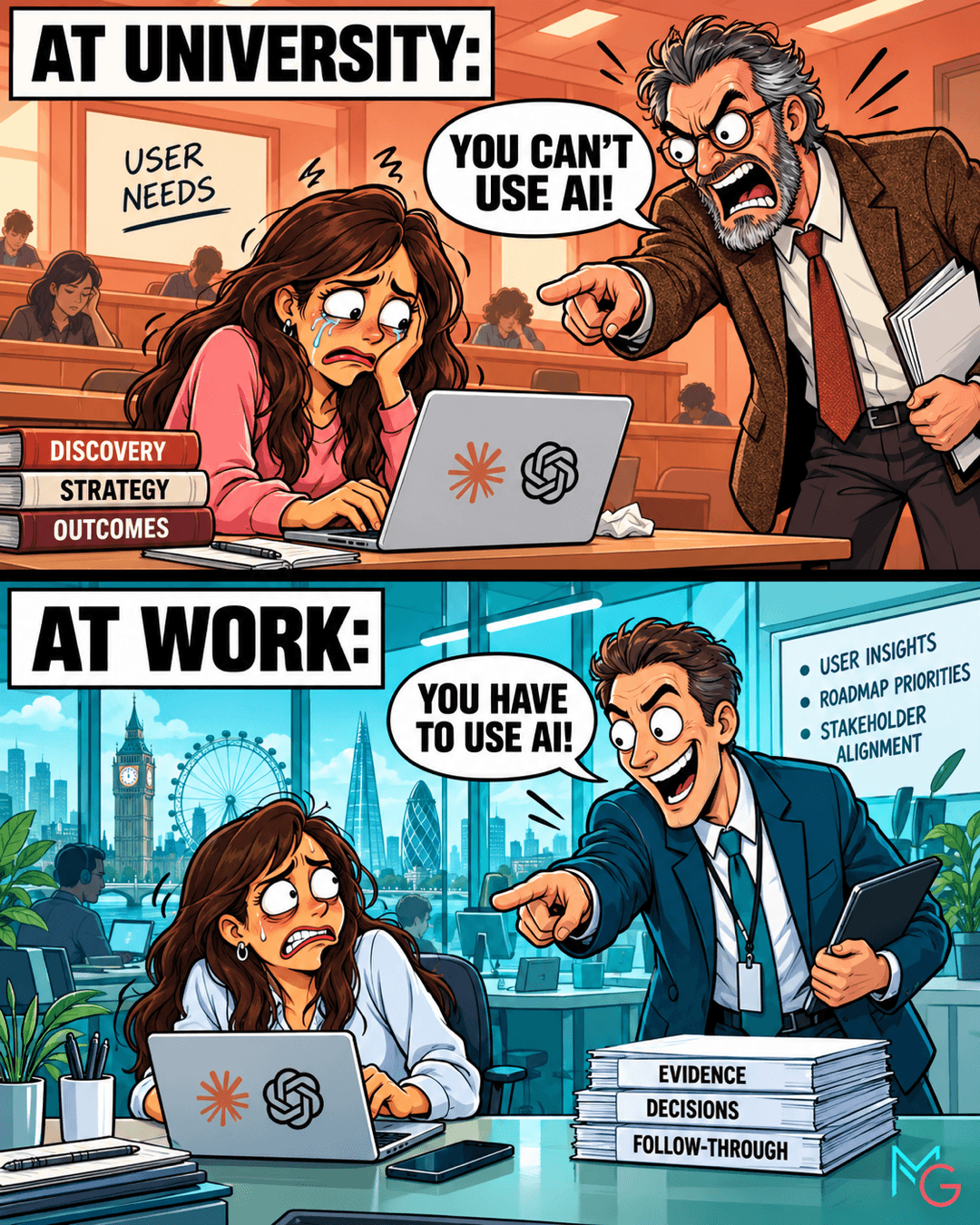
The university got the rule wrong. They got the fear exactly right.
At university, the message is "you can't use AI". At work, it is "you have to use AI". Product managers sit between the two, and the easy take is that universities are behind. That is not what this piece is about.
The fear behind those bans points at something every product manager should care about. AI makes your work look done before your thinking is. A PRD, a roadmap or a research summary can arrive polished in minutes, and the polish says nothing about whether a decision was ever made.
So here is how to tell whether AI helped you decide, or decided for you. It ends with five questions to run on any piece of work before it reaches your team.
What the AI bans are protecting
Whatever you think of the rule itself, those bans protect something real: the habit of reaching your own view before anything else does. You read, you struggle with it, you form a position, and only then do you test it against other people's.
Product decisions need exactly that habit. Product work rarely starts with a clear brief. The data is partial, stakeholders want different things, and customers describe symptoms rather than causes. The PM who has a view of their own in that fog is the one the team can follow. The PM who borrowed the first plausible answer has nothing to stand on when the questions start.
Your value is the judgement behind the artefacts
A PM's value was never the PRD, the roadmap or the research summary. Those are outputs. The value is the judgement behind them, made when nothing is clear yet. Which problem matters. Which evidence to trust. What the customer actually meant. What to build, and what to refuse.
Your team and your stakeholders rely on those calls even when they never see them. A roadmap is only as good as the choice about which problem goes first. A research summary is only as useful as your read of which quotes matter and which are noise.
That is the career point underneath the whole debate. Artefacts are getting cheaper to produce. The judgement behind them is not, which makes it the part of the job worth protecting and the part worth getting better at.
How AI makes product work look finished too early
AI can make your product artefacts look finished before the thinking behind them is. A spec with clean headings, a confident problem statement and a tidy list of risks reads like the work of someone who has made up their mind. It may be the work of someone who pressed enter.
The risk is that you get faster at producing work without getting better at deciding what the product or your team needs. Output goes up. The quality of the calls stays where it was, and nobody notices for a while because the documents look great.
The hard part is that there is no moment of choice. Nobody decides to skip the thinking. AI makes it easy to skip it without noticing you have. The draft looked right, the deadline was close, and the decision got made by whatever the model produced first.
How to use AI without handing over the decision
None of this means using less AI. Used well, it makes your judgement stronger, because it widens what you can see before you decide. Four uses help most.
Find more evidence. Ask AI to pull together support tickets and interview notes, so your view rests on more than the last loud conversation.
Generate alternatives. Before you commit to an approach, ask for five other ways to solve the same problem. Even the weak options show you what you are really choosing between.
Challenge your assumptions. Write down what you believe and ask AI to argue against it. Treat the pushback as a list of things to check, not a ruling.
Stress-test your recommendation. Ask how the plan fails and who will object to it. A recommendation that survives that is one you can defend in the room.
In every case, AI does the legwork and you make the call. Just don't mistake its answer for your judgement.
Five questions to check your own product judgement
Every PM I coach gets these five questions. Most find at least one is harder to answer than they expected, and that discovery is the useful part. It shows you exactly where the thinking still needs to happen.
Run them on any AI-assisted PRD, roadmap or recommendation before it reaches your team. If you can answer all five in your own words, AI helped you decide.
Why is this the right problem?
AI will happily solve whatever problem you hand it. It will not tell you that a different problem matters more. Before anything else, say why this problem, for this customer, now. Name what you looked at and what you set aside. If the real reason is "it was next on the list" or "the prompt framed it that way", the problem choice was never really made.
What evidence changed your mind?
A decision where nothing changed your mind is often a decision you had made before you started. Name one piece of evidence that moved you, even slightly: a customer quote, a usage number, a pattern in support tickets. If AI gathered the evidence, check that you read the source and not only its summary. Evidence you can't point to is evidence the team can't trust.
Which options did you reject?
A recommendation with no rejected options looks like the only path. It rarely is. List the two or three alternatives you considered and why each lost. Generating alternatives is cheap now, so AI helps a lot here. The judgement is in the rejecting, and in being able to explain it to someone who preferred the option you turned down.
Why is this trade-off worth it?
Every product decision costs something: scope, time, a segment you will serve less well, a stakeholder you will disappoint. AI-written documents tend to list trade-offs without choosing between them. Say which cost you are accepting and why it is worth paying. If you can't name the cost, you haven't found the trade-off yet.
What would prove you wrong?
Write down the signal that would tell you the decision was a mistake, and when you expect to see it. A number, a behaviour, a date. Without it, any result can be read as success. With it, the team knows what to watch, and you know when to change course instead of defending the plan.
Faster output, better calls
The university and the workplace are giving opposite instructions, and each has a point. AI belongs in product work. So does the habit of reaching your own view first. The PMs who grow from here will use AI to see more, and still make the call themselves.
Take the five questions to your next PRD before it goes out. Then try asking your team to run them on each other's work. It may feel uncomfortable the first time, and it is one of the fastest ways to build a team whose thinking holds up as well as its documents do.
For a wider set of checks on reviewing decisions, the Product Management Cheat Sheet: Judge the Thinking, Not Just the Result goes further.