You didn't lose your product instincts. You took a job that doesn't let you use them.
At senior level, the skill gap between people is smaller than most people want to admit. The conditions are not equal. And almost no one talks about the conditions.
Below are 15 conditions. In a great role, these are just how work works. In most roles, they are rare enough to feel like luxuries.
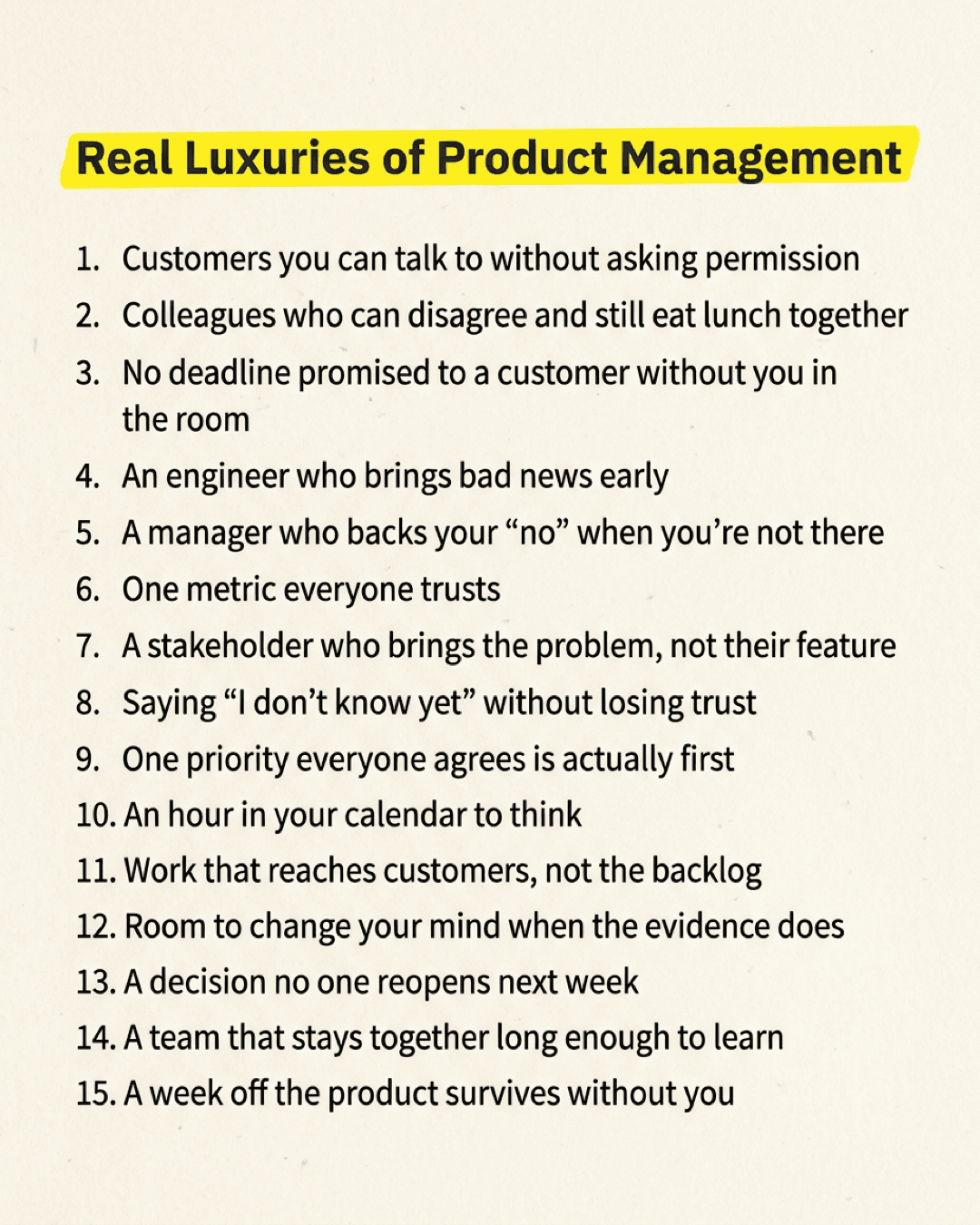
The 15 real luxuries of product management
1. Customers you can talk to without asking permission.
2. Colleagues who can disagree and still eat lunch together.
3. No deadline promised to a customer without you in the room.
4. An engineer who brings bad news early.
5. A manager who backs your "no" when you're not there.
6. One metric everyone trusts.
7. A stakeholder who brings the problem, not their feature.
8. Saying "I don't know yet" without losing trust.
9. One priority everyone agrees is actually first.
10. An hour in your calendar to think.
11. Work that reaches customers, not the backlog.
12. Room to change your mind when the evidence does.
13. A decision no one reopens next week.
14. A team that stays together long enough to learn.
15. A week off the product survives without you.
None of these are skills. Every one of them is something the environment gives you or doesn't. And every one of them changes how good your product calls can be.
Count yours: best role, worst role
I've worked where all 15 were just Tuesday. And where 3 felt impossible. I was stuck for months and couldn't explain it.
There was no list. Nothing to point at. I just assumed it was me.
The count matters because missing conditions are hard to see from inside the role. Without a list, a missing condition feels like a personal failing. With one, it becomes something you can name, point at and change.
So count yours. Score your best role out of 15. Then score your worst. The gap between those two numbers is not you. It is the conditions you were working in.
Don't push harder. Go one level up
When something feels off, the instinct is to push harder. That is the wrong fight. You are not fixing a missing condition with more effort.
Go one level up. Name the condition you are missing. Then build it, negotiate it, or escalate until someone owns it. One this quarter.
Some you can build yourself, like protecting an hour in your calendar to think. Some you have to negotiate, like being in the room before a deadline is promised to a customer. Some only change when someone senior owns them. The move is the same in each case: name it, then put it on someone's plate.
Make your next interview an audit
Your next interview should be an audit. Not just comp. Not just team size.
Ask how many of these 15 they can genuinely offer. The ones who struggle to answer are telling you everything.
You were not underperforming. You were under-resourced. Those are not the same thing, and the difference matters. Put a good PM in a bad system and the system wins. Every time. And most organisations never notice what they are losing.
What is your score out of 15? And which one missing would change the most for you right now?