Most people still get remote product work wrong.
They picture a product manager in pyjamas, long coffee breaks, and not much shipped. The real version is quieter on the surface, more organised and more deliberate. Remote work does not remove the hard parts of product management. It moves them, and in a few places it makes them harder to fake.
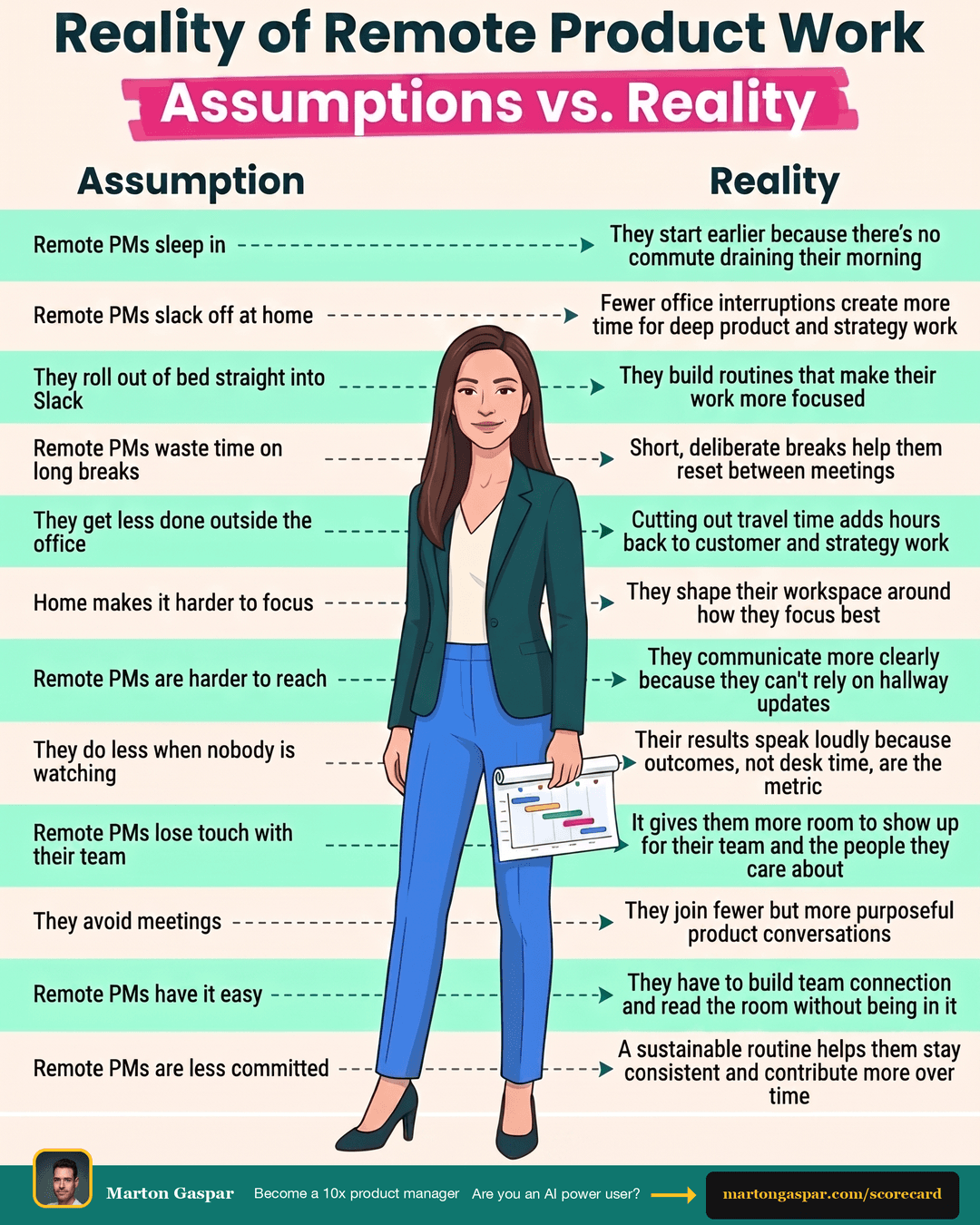
Here are twelve common assumptions about remote product managers, set against what the work looks like once you drop the stereotypes. They fall into three groups: how the day runs, how the work gets done, and how the team holds together.
How the day actually runs
Morning. The assumption is that remote PMs sleep in. The reality is that many start earlier, because there is no commute eating the morning. The first hour goes to work rather than to a train.
Routine. The assumption is that they roll out of bed straight into Slack. The reality is that they build routines that keep the work focused. Without an office to give the day its shape, the shape has to be designed.
Breaks. The assumption is that they waste time on long breaks. The reality is short, deliberate breaks that reset them between meetings. A back-to-back day of video calls needs gaps on purpose, or the quality of every later conversation drops.
Setup. The assumption is that home makes it harder to focus. The reality is that they build the workspace around how they actually focus. That is a choice an open-plan office rarely gives anyone.
How the work gets done
Focus. The assumption is that remote PMs slack off at home. The reality is that fewer office interruptions mean more room for deep product and strategy work. The thinking that suffers most in an office, the long stretch spent on one hard problem, often gets more space at home.
Output. The assumption is that they get less done outside the office. The reality is that cutting the commute puts hours back into customer and strategy work.
Communication. The assumption is that remote PMs are harder to reach. The reality is that they write more clearly, because there is no hallway to lean on. A decision that would have been settled in a corridor has to be written down, and a written decision is easier for the whole team to find later.
Accountability. The assumption is that they do less when no one is watching. The reality is that the results talk, because outcomes are the metric, not desk time. Remote work strips away the signal of being seen at your desk, which leaves the work itself as the main evidence.
Meetings. The assumption is that remote PMs avoid meetings. The reality is fewer meetings, but the ones they join actually move the product.
How the team holds together
Team. The assumption is that they lose touch with their team. The reality is more room to show up for the team and the people they care about.
Difficulty. The assumption is that remote PMs have it easy. The reality is that they still have to build the team bond and read the room without being in it. Picking up hesitation from a muted microphone, or spotting that a quiet engineer disagrees, takes more effort when nobody shares a desk.
Commitment. The assumption is that they are less committed. The reality is that a routine they can keep is what makes them steady over time.
Remote work raises the bar
Read the twelve together and the pattern is clear. Remote product work does not lower the bar. It raises it, on clarity, ownership and rhythm.
Clarity, because writing replaces the hallway. Ownership, because outcomes replace desk time as the measure. Rhythm, because nobody else designs your day for you. Each of those is a core product skill in any setting. Remote work just makes their absence easier to see.
If you lead or work with remote PMs, it is worth asking which of these assumptions your team still makes, and what it costs you.