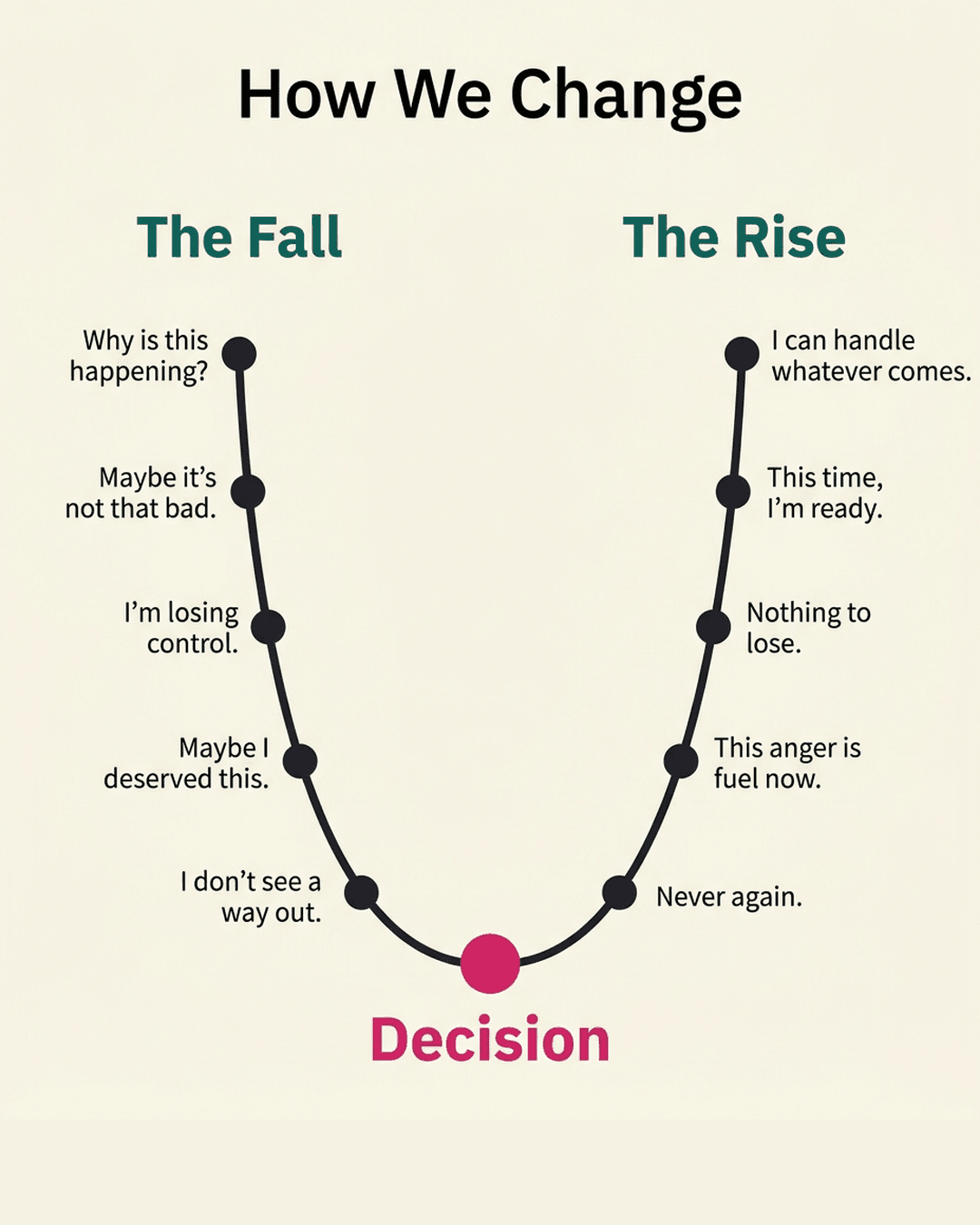
Rock bottom does not create the change. It takes away the excuses.
The "How We Change" curve shows it plainly. On the way down: why is this happening, maybe it's not that bad, I'm losing control, maybe I deserved this, I don't see a way out. At the bottom sits a single point labelled Decision. On the way up: never again, this anger is fuel now, nothing to lose, this time I'm ready, I can handle whatever comes.
The turn happens at the decision, not at the crash. The crash just removes every reason to put the decision off.
There is no crash coming
For most product managers there is no obvious rock bottom on the way. No quarter fails. No project dies. The way you work simply goes out of date before anyone says so.
The curve in the image is drawn around a fall, and the lines on the way down are ones most people recognise. When your way of working goes out of date slowly, there is no single moment where you hit the bottom and turn. The decision point still exists. It just has to be chosen rather than forced.
That is the harder version, because nothing forces the decision. So take the excuses away on an ordinary Tuesday instead. You do not need more information. You need fewer reasons to wait.
The three excuses that sound like plans
Usually the waiting sounds like this:
"After this launch."
"I'll wait until things stop changing so fast."
"I already use AI."
The first two are just scheduling. They sound like plans, but they push the decision to a date that never arrives.
"I already use AI" was mine, and it is the expensive one, because it is true. Using AI is a habit. Building something that improves without you is an asset. Skills decay. Systems compound. The techniques you learn this month are worth less next year. The systems you build are worth more.
What "I already use it" looked like for me
That was me. Notion in one tab, ChatGPT in the other, moving text between them and calling it a workflow. Five turns to get one decent email. Every task started from scratch.
It was using AI. It was also as far as I had got. Because every task started cold, nothing I did one day made the next one easier.
My setup now builds parts of my roadmap on its own. I check the work, I do not drive it. Two years ago I did not know that was a level.
Retire all three on purpose
Each excuse has a direct answer.
"After this launch" becomes a week in the diary. There is never a good one, so pick one and protect it like any other commitment.
"When things stop changing" becomes a setup that takes change in. Things will not stop changing. There is a new tool next month, and the month after. Build one setup that takes each new tool in, instead of starting over each time.
"I already use it" becomes a simple test. Write down what your setup does when you shut the laptop. If the answer is nothing, you do not have a system yet. You have a habit.
The same decision, a year earlier
Building AI fully into how you work is a journey, and the first step is knowing where you are on it. The free assessment at martongaspar.com/scorecard shows where you stand and what your most useful next step is.
No rock bottom required. Just the same decision, a year earlier.
Which of those three has been costing you the most?
Image inspiration: X Kalam Center.