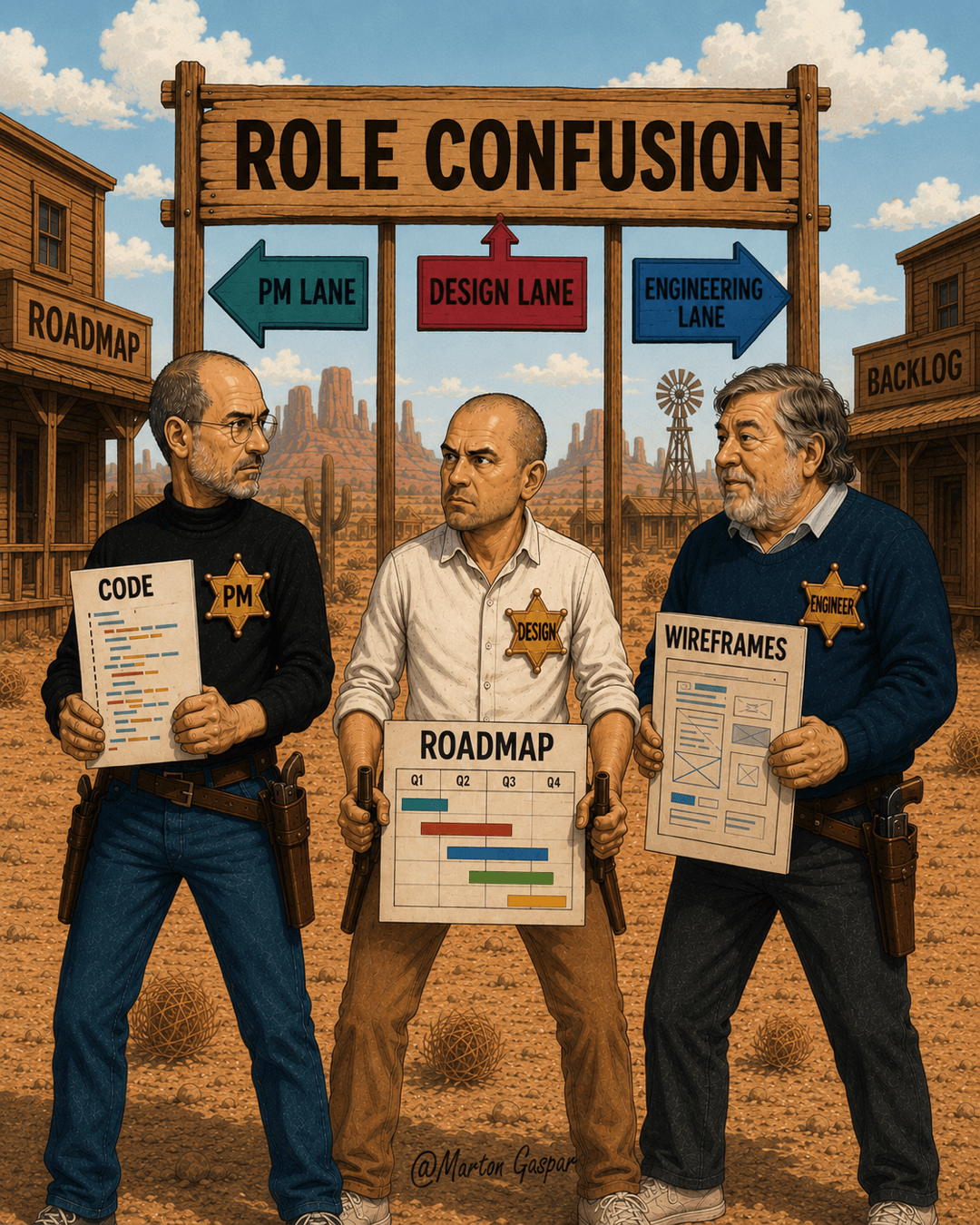
Product managers, stop cosplaying as engineers. You're abandoning the one task AI can't do.
The same pattern keeps turning up. Product managers writing code. Engineers redesigning screens. Designers drawing up the roadmap. Everyone doing someone else's job, and the one that's actually theirs goes unowned.
It isn't anyone's fault. AI made building so cheap that everyone started chasing the wrong job. The tools that let a product manager ship a working prototype in an afternoon also let an engineer mock up a new flow, and let a designer sketch a quarter's plan. The lanes blurred. This page is about why that happens, what it costs, and the one decision that still belongs to the product manager.
The standoff in the picture
The image shows three people at a crossroads in a western town, under a sign that points three ways: PM lane, design lane, engineering lane. The one wearing the PM badge is holding code. The one wearing the design badge is holding the roadmap. The one wearing the engineer badge is holding the wireframes.
Each of them is armed and none of them is in their own lane. It's a standoff: everyone watching everyone else, nobody doing the work they were hired for, while the Roadmap and Backlog buildings behind them sit empty.
You don't have to be in it.
Why AI pulled everyone out of their lane
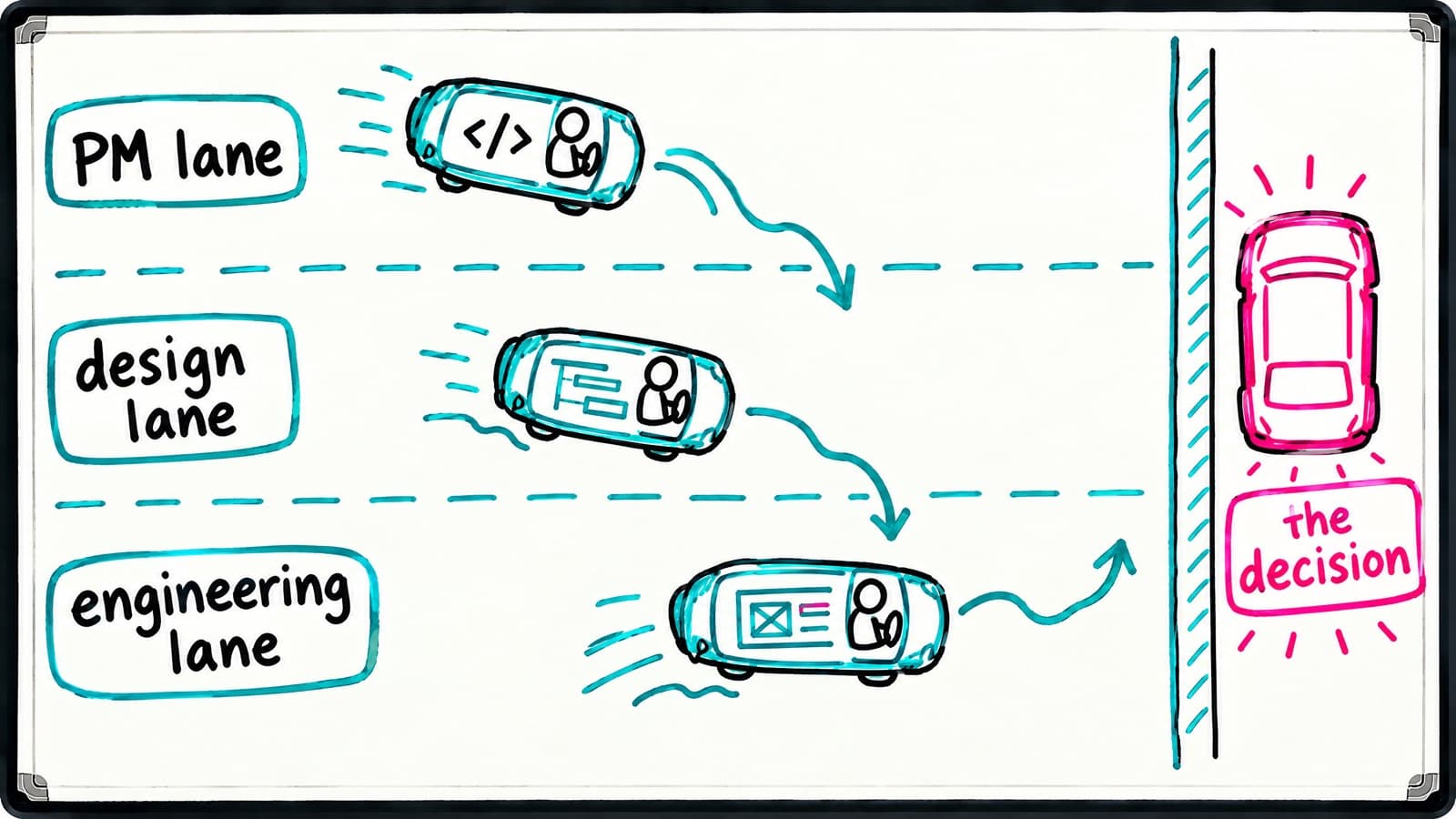
When building was expensive, roles stayed separate because the work was hard to cross into. A product manager couldn't ship a feature without engineers. An engineer couldn't produce a polished design without a designer.
AI removed a lot of that friction. Now anyone can generate code, screens or plans that look finished. That's useful, and it's tempting. Building something feels productive. It produces a visible artefact by the end of the day, and it feels like keeping up with AI.
The trouble is that the easy work is easy for everyone, including the AI. Writing code is exactly the kind of task AI keeps getting better at. So a product manager who spends their week coding is competing in the lane where they're least needed and easiest to replace.
The cost of everyone doing someone else's job
When everyone moves into the visible work, the invisible work goes unowned. And in product, the invisible work is the decision about what to build at all.
Teams in role confusion ship a lot and decide very little. Prototypes multiply. Opinions about screens multiply. Nobody has said clearly which problem matters most and what the team is betting on, so the output points in five directions at once.
It also wears down trust. Engineers don't love a product manager rewriting their code. Designers don't love an engineer reworking their screens. Each crossing reads like a small vote of no confidence, and the standoff hardens.
Signs your team is in the standoff
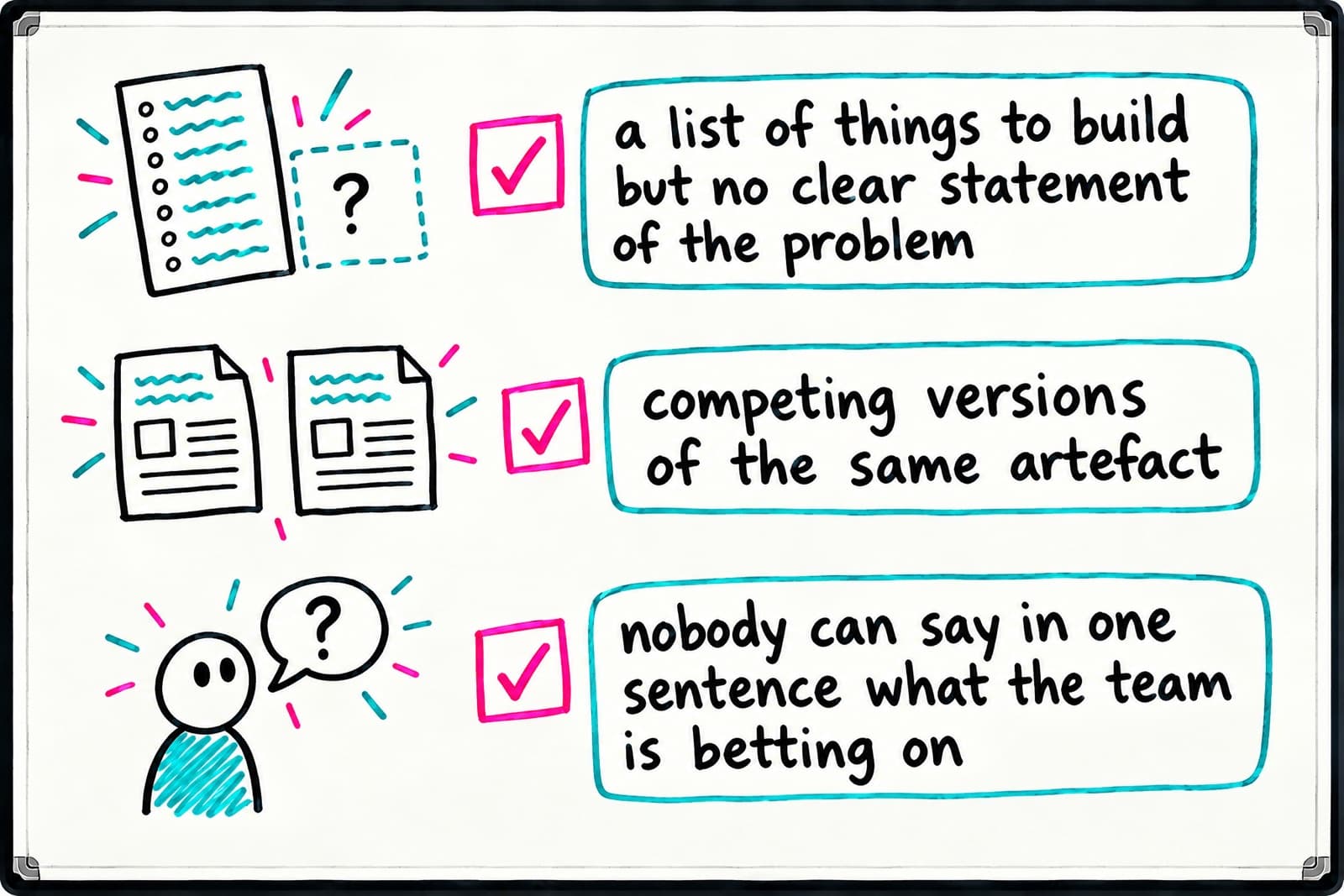
A few signals show up early. Planning meetings end with a list of things to build but no clear statement of the problem behind them. Reviews turn into debates about implementation details that belong to someone else. Two people produce competing versions of the same artefact in the same week. The product manager's calendar is full of building, and nobody can say in one sentence what the team is betting on this quarter.
None of these mean anyone is bad at their job. They mean the lanes blurred and nobody noticed. The fix starts with the person whose lane is the decision.
The one decision AI still can't make
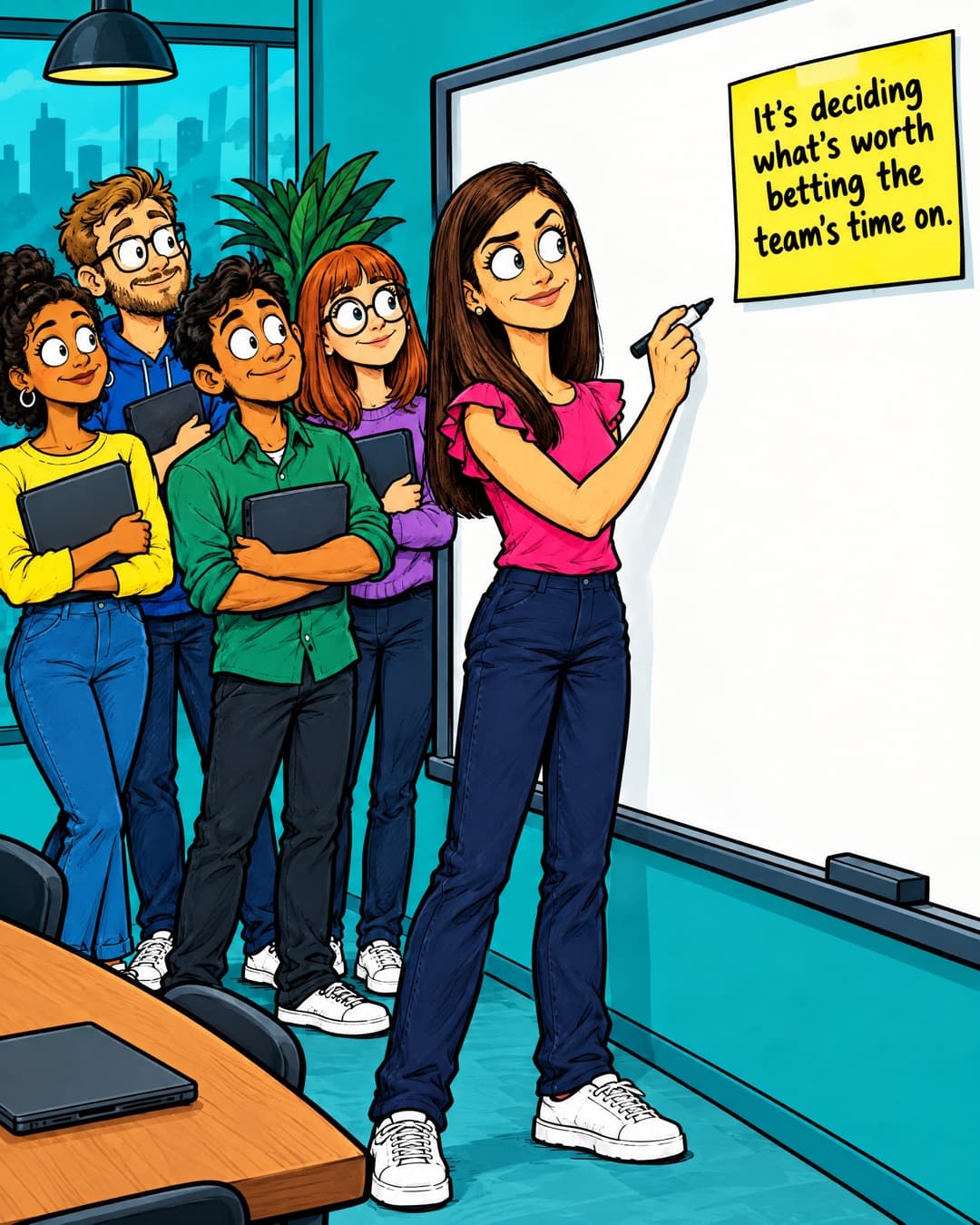
There is one decision AI still can't make for you. It happens before there's data. Before there's a prototype. Before a customer has said a word. Before there's code.
It's deciding what's worth betting the team's time on.
That call is made with incomplete information, about a future nobody can measure yet, and someone has to own it with their name on it. AI can help you research, summarise and test. It can't carry the accountability for choosing where a team spends its next three months. That's the product manager's job.
The people pulling ahead didn't become better engineers. They became harder to replace, by owning the call nobody else in the room is positioned to make.
How to own your lane again
Start by noticing where your week goes. If most of your hours are spent producing artefacts someone else is better placed to produce, that's the signal to step back.
Then do the work that only your lane can do. Write down the problem the team is solving and why it matters now. Name the bet: what you expect to happen and what would prove you wrong. Decide what the team will not do this quarter, and say it out loud. Use AI to speed up your research and testing, so you get to a better decision faster, not to produce code that isn't yours to write.
Building a quick prototype to test an idea is still fine. The point isn't that product managers must never touch a tool. The point is that the prototype serves a decision, and the decision is yours.