You spent a decade getting fast at product. AI just made fast irrelevant.
Seniority is not being reinvented. It is being exposed.
For years, speed was one of the easiest ways to tell a senior product manager from a junior one. The senior PM could turn a vague brief into a clear spec in a day, get a prototype in front of users in a week, and keep a team moving while others were still working out where to start. Speed was visible, and it was easy to reward. Promotions, reviews and reputations were built on it, often without anyone asking what sat underneath.
More paths, not a straighter one
AI can turn one brief into five plausible prototypes before your team has agreed which problem is worth solving.
That does not straighten your path. It puts more possible paths within reach. When a first version costs almost nothing, the question is no longer whether you can produce one. It is which of the many you could produce deserves the team's time.
Output alone was never the whole measure of a senior PM. It was just the part that was easiest to see. What becomes more visible now is the harder part underneath it.
What seniority now looks like
Three calls separate senior product work from fast product work.
Which problem is worth committing to. Five prototypes can answer five different problems. Someone has to decide which one matters most to the customer and the business, and commit the team to it while the other four still look attractive.
What evidence should change your mind. A senior PM sets out in advance what would make them drop or change a direction. Without that, cheap prototypes produce endless options and no way to choose between them.
Which trade-offs you are prepared to own. Every choice gives something up. Seniority shows in naming what you are giving up, out loud, and standing behind it when someone asks why.
None of these calls got cheaper. If anything, they carry more weight, because the cost of building the wrong thing quickly is still the cost of building the wrong thing.
The loops are still there
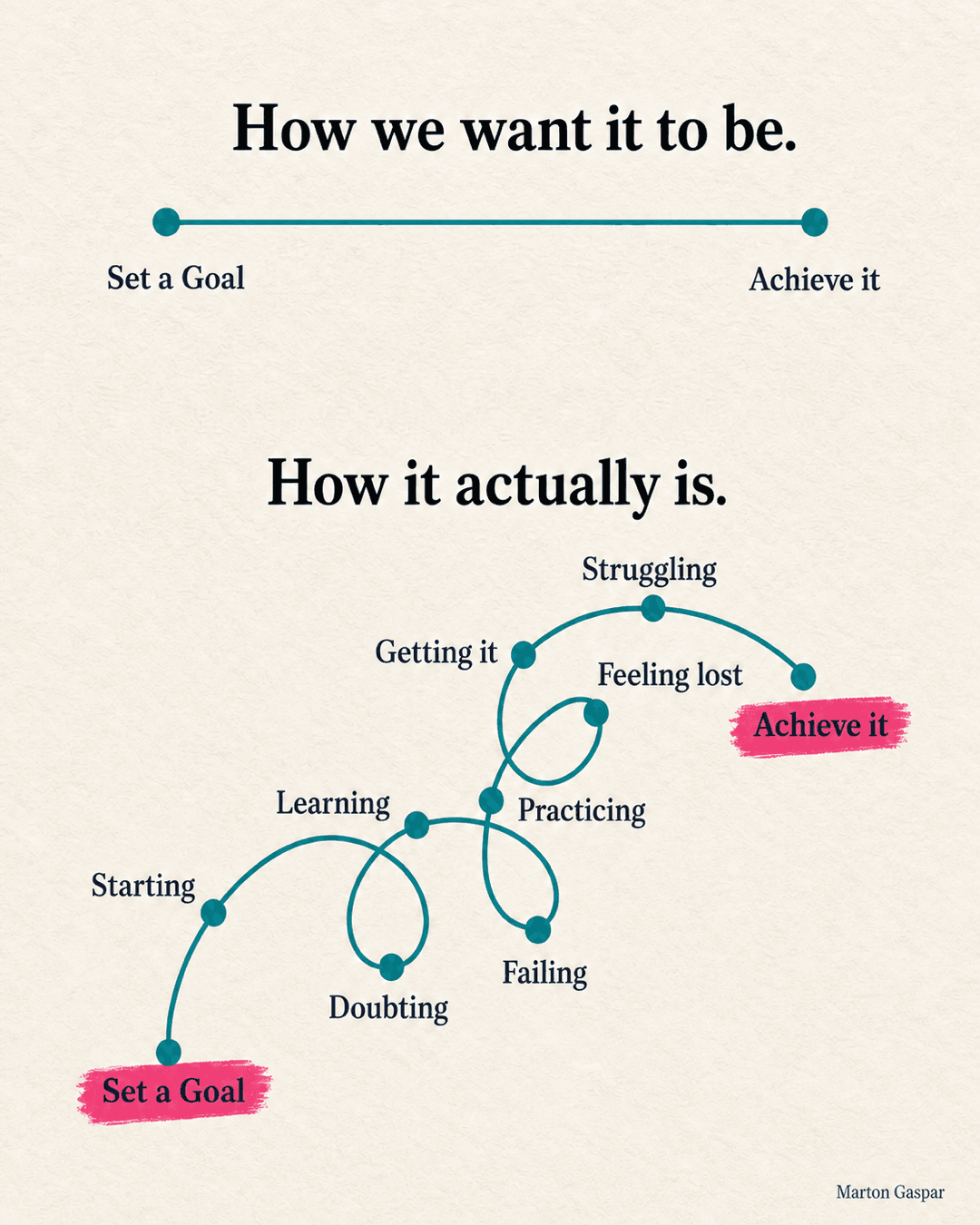
The picture most people carry of progress is a straight line: set a goal, achieve it. The real picture is a tangle. Starting, learning, doubting, failing, practising, feeling lost, getting it, struggling, and only then arriving.
The loops are still there in a senior product career. The doubt, the failure, the stretch where you feel lost. AI does not remove them.
They can build your judgement, but only when what you learn there changes your next product call. Without the learning, a loop is repetition, not progress. A loop that never changes a decision adds years, not seniority.
That is the useful test for anyone with a long product career behind them. Not how many years, and not how fast, but whether each loop left you making better calls than the one before.
First versions got cheap. Choosing what to build did not.
Ask yourself one question about the work in front of you this week: what evidence would change the product call you are making today?
If you can answer it clearly, that is the senior part of the job at work. If the answer is fuzzy, that is worth knowing too, because it shows where the next loop of learning sits.
Want to know where you actually stand? The three-minute scorecard is at martongaspar.com/scorecard.