Spotify's 90% token cut was built by a product manager.
One rule did it. He decided which work gets the expensive model, and which work doesn't.
That call should feel familiar, because it is how product managers already operate. People, time, budget: every day you decide where the scarce thing goes. AI is just the newest thing to spend.
Every team using AI has this call waiting. The PM who makes it is the one who stops paying top price for routine work. And knowing which calls need the best model, and which need you, is the part of the job AI is making more valuable.
Below is the rule, how it works, what the number really covers, and three steps to write your own version this week.
The rule: the expensive model never reads a big file in full
Dimitri Mazmanov, a Product Manager at Spotify, turned that call into one rule. Claude, his most expensive model, never reads a big file in full.
A full read of any file over 350 lines gets blocked. A cheaper model reads it instead and hands back only the answer. Claude can still open the exact section it needs to edit. And the debugging and design calls stay with Claude.
The split follows what a mistake would cost. Reading a long file to find one fact is routine. Deciding how to fix a bug is not. So the routine reading goes to the cheaper model, and the judgement stays with the best one.
Why a hard block beats a good habit
He made it a hard block, so it holds even when nobody's watching.
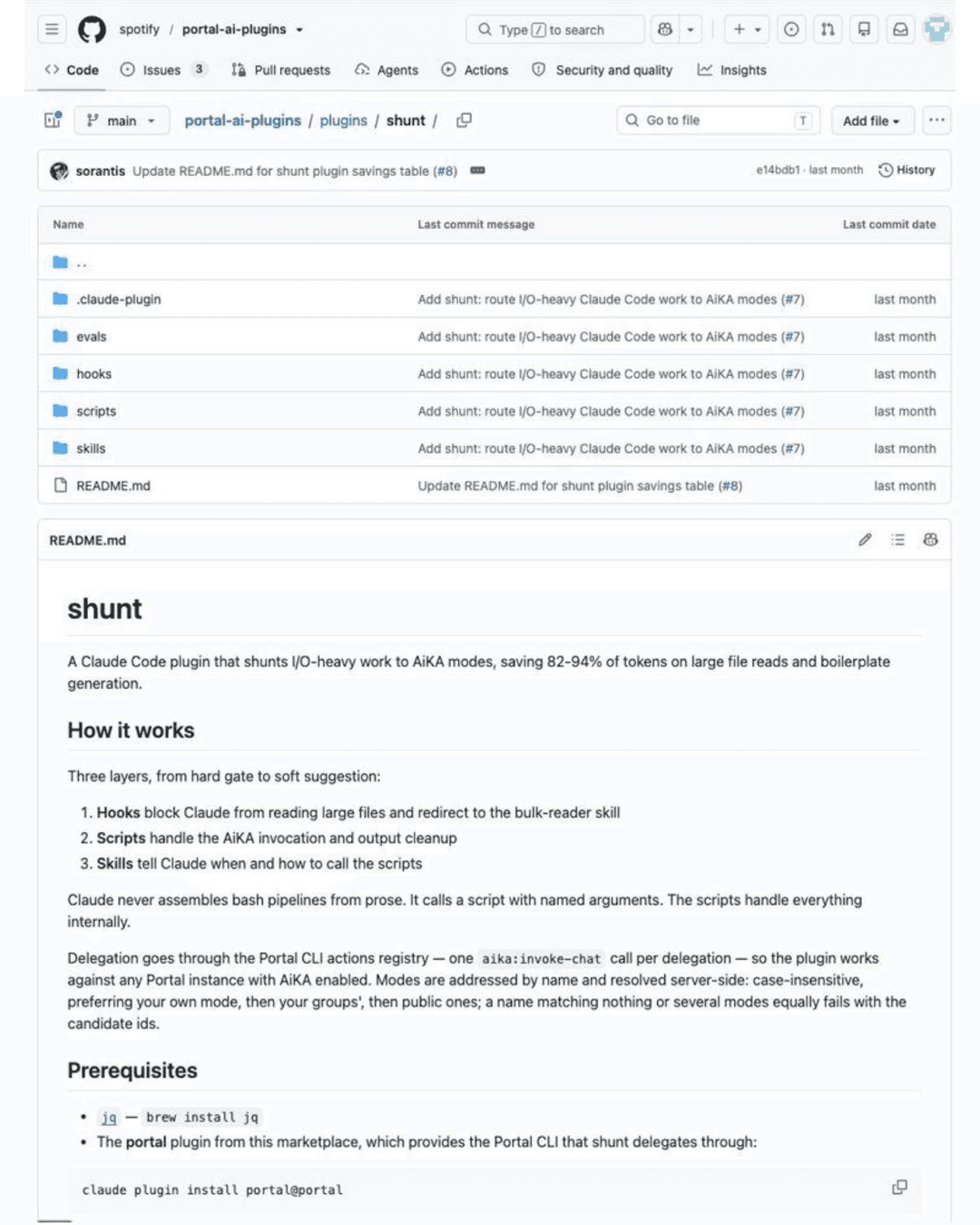
That detail matters as much as the number. A guideline depends on someone remembering it at the right moment. A block doesn't. The plugin is called shunt, and it sits in Spotify's public portal-ai-plugins repository. Its README describes three layers, from hard gate to soft suggestion: hooks that block Claude from reading large files and send the work to a bulk-reader skill, scripts that handle the call to the cheaper model, and skills that tell Claude when and how to call those scripts.
The hard gate comes first and the suggestions come after. That order is a product decision in itself. The rule that protects the budget is the one nobody can skip.
What the 90% actually covers
Read the number carefully before you quote it. The 90% is on reading big files, across three tests. The full bill wasn't reported. The plugin's README gives a range of 82 to 94% of tokens saved on large file reads and boilerplate generation.
So this is not "Spotify cut its AI bill by 90%". It is a large saving on one kind of work, measured on that work. That is still worth having, and it is the accurate way to describe it.
Your setup isn't Spotify's, and it doesn't need to be
You don't need his tools to copy the rule. Your best model and your own attention go where a mistake would change a decision. Everything else goes somewhere cheaper.
Your week already has the same call in it. Pulling quotes from a pile of interview transcripts is a job for a cheap model. Spotting where what users said and what they did disagree needs your best model. Deciding what to build from it is yours.
Written as one line for your team, the rule looks like this:
"[routine job] → the cheaper model. [job that feeds a decision] → the best model, then me."
Step 1: Sort the AI jobs in your week
List the AI jobs in your week. Then mark the ones where a mistake would change a decision.
That one mark does the sorting for you. A job where a mistake costs a re-read can go to the cheaper model. A job where a mistake would change what the team does gets your best model, and then you.
Step 2: Write the rule down where the work runs
Before you roll it out, note this week's usage on your AI tool. That is your baseline.
Then put the rule where the work runs: project instructions, prompt templates, your team's AI guide. Written there, it holds without anyone remembering. It is the same idea as the hard block at Spotify, at whatever level your own setup allows.
Step 3: Prove it in your next retro
Mind you, the cheap reader isn't perfect. In his tests it missed a subtle bug that Claude caught. A miss like that is a good reason to keep debugging calls on the best model, and a good reason for your rule to carry a check.
A week in, spot-check 3 answers against the source and check the usage again. Take the before and after to your next retro. Now the rule has evidence behind it, and the team can see both what it saved and what it cost.
How I run the same idea
My own setup runs on the same idea. Big reads and searches across lots of files go to helper agents, and only the answer comes back. Routine code goes to a separate coding agent. My voice, strategy, money and passwords never get handed off. And nothing reviews its own work: a different model checks it.
Where your best model goes is a product decision
Make it like one: written down, owned, checked in the retro.
The rule decides where the spend goes. The other half is reporting what it bought. Measuring AI Token Spend (/vault/measuring-ai-token-spend) covers three questions that show what your tokens paid for in delivery, discovery and operations.
Which job in your week would you never hand to a cheaper model?
Every product manager has an AI profile. What's yours? Find out at martongaspar.com/scorecard.