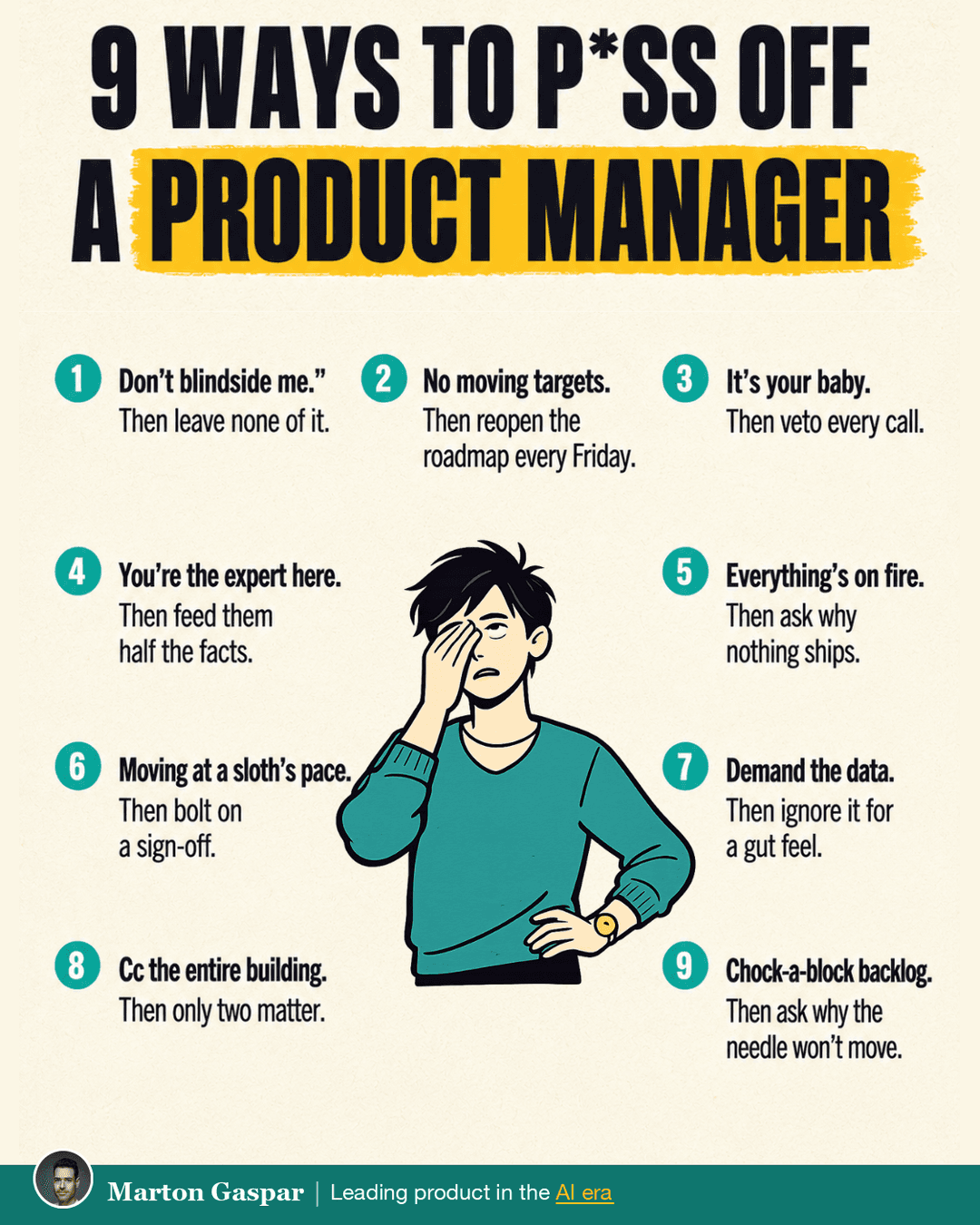
Your stakeholders are gaslighting your product team. Nine ways, and then they blame you when nothing ships.
If you've worked in product for a while, you've probably lived every line below. The exhaustion isn't the workload. It's fear that was never yours to carry, and you can put it down.
Here is what gaslighting at work looks like: warm words, cold actions, and you're the one left doubting yourself. A stakeholder who says "it's your baby" and then vetoes every call isn't trusting you. They want you carrying the blame while they keep control of every decision.
These are the nine patterns. Each one is a thing that gets said, followed by a thing that gets done.
"Don't blindside me." Then leave you none of it.
They ask for no surprises. They want to hear about every risk early. Then the same courtesy never travels the other way, and you find out about their decisions when they reach your team.
"No moving targets." Then reopen the roadmap every Friday.
Stability is demanded of the team. The roadmap itself is treated as a draft that anyone senior can reopen at the end of any week. The team gets blamed for not finishing what was never allowed to stay still.
"It's your baby." Then veto every call.
This is the clearest version. Ownership is handed over in words and taken back in practice. You hold the accountability. They hold the decisions. It's also the pattern most likely to make you doubt your own read of the situation, because the words and the actions point in opposite directions.
"You're the expert here." Then feed you half the facts.
You're asked for your judgement and given an incomplete picture to make it with. When the call turns out wrong, the missing half never comes up. The expertise was real. The information it needed wasn't there.
"Everything's on fire." Then ask why nothing ships.
Every request arrives as urgent. The team spends the quarter switching between fires. Then the question at the review is why nothing big got finished. When everything is on fire, nothing is a priority, and the team pays for it twice: once in the switching, and again in the review.
"Moving at a sloth's pace." Then bolt on a sign-off.
The team is told it's too slow. The fix is another approval step. Each new sign-off adds the delay that the next complaint will be about.
"Demand the data." Then ignore it for a gut feel.
You're asked to prove the case with evidence. You do the work. Then the decision goes the way someone already felt it should, and the data drops out of the conversation.
"Cc the entire building." Then only two people matter.
Every update goes to a long list. In reality two people make the call. The rest add noise, opinions and delay, and you spend your week managing the list instead of the decision.
"Chock-a-block backlog." Then ask why the needle won't move.
The backlog fills with everything anyone asked for. The team ships a long tail of small things. Then someone asks why the one number that matters hasn't changed.
How to stop absorbing it
None of these patterns is your fault, and you don't have to keep absorbing them. Five moves help.
When they say "your call", make them say it in the room, not just to you. A decision handed over in private can be taken back in private. A decision handed over in front of others is much harder to reclaim.
Ask "what would change your mind?" Once the condition is on the table, the goalposts stop moving, because everyone heard where they were.
Put the decision in writing, then hold them to it. A short written note of what was agreed, by whom, turns a conversation into a commitment.
Protect the one real priority out loud. Let the rest wait. Saying it in public makes the trade-off visible, so the next urgent request has to compete with something everyone can see.
Stop cc'ing the building. Name the two people who actually decide, and work with them directly.
None of that is being difficult. It's refusing to carry fear that isn't yours.
For more on winning support from people you don't manage, see /vault/how-to-influence-without-authority. When the pressure arrives as one urgent request after another, /vault/how-to-push-back-on-urgent-requests covers the questions to ask.
It was never your fear to carry
You were never slow. You were the only one in the room holding everyone's fear.
Every pattern above moves risk from the person with the power onto the person with the accountability. Naming the pattern is the first step. Refusing to hold what isn't yours is the second.
What would you add as the tenth?