I used to be ChatGPT's copy-paste monkey. Now AI does my work while I'm asleep.
If you use AI at work, there are three levels. Most people can name theirs. Almost nobody can picture the one above it.
The easiest way to see the difference is to take one piece of work through all three. So here is one email, at each level: the weekly update.
You have written it forty times. You still start from a blank page or a template, and by the time you hit send, two lines of it are already out of date.
It is a small task, and that makes it a good test. Nobody's career turns on a weekly update. But how you handle it shows how you work with AI on everything else. The gap between the levels is the gap between AI saving you a few minutes and AI changing what your week is spent on.
Level 1: You prompt AI
New chat. Last week's update, your meeting notes, paste.
What comes back is full of em dashes and the stock words everyone has learned to spot. Everyone can tell it was written by AI. Five rounds later you rewrite it yourself anyway.
The problem at this level isn't the model. It knows nothing about you, your product, or what a good update looks like to the people who read yours, so every session starts from scratch.
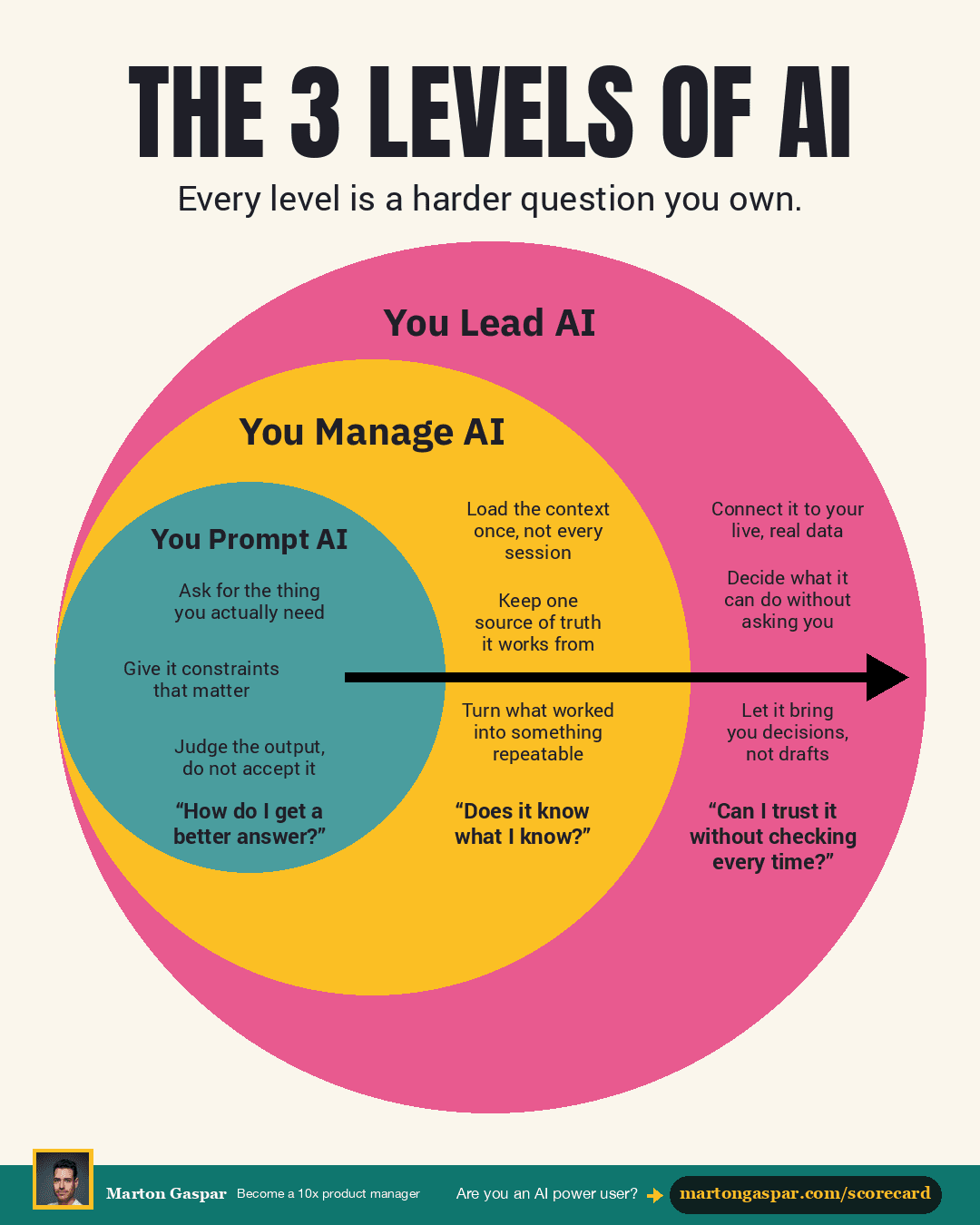
The question at this level is "How do I get a better answer?" The work is asking for the thing you actually need, giving it the constraints that matter, and judging the output instead of accepting it.
The step up is one Project in ChatGPT or Claude. Put in five updates you actually sent, plus the instructions you keep retyping. That is your voice, locked.
Level 2: You manage AI
Same update, but you open the Project instead of a blank chat.
The draft comes back sounding like you. It just doesn't know this week, so you paste the notes in, or talk it through in a voice note. Two edits and it goes. The voice problem is solved. What is left is the context problem: it can only write about what you remember to give it, and you are still the one carrying the week's notes across.
The question at this level is "Does it know what I know?" The work is loading the context once instead of every session, keeping one source of truth it works from, and turning what worked into something repeatable.
The step up is to connect it to wherever your meeting notes already live. Then it reads this week's notes itself.
Level 3: You lead AI
Same update. You ask for it and it is there.
No pasting, because it reads your meeting notes and your last twelve updates itself. It comes back with what changed this week, what didn't, and why. You review it and send it. The only job left is remembering to ask.
The question at this level is "Can I trust it without checking every time?" The work is connecting it to your live, real data, deciding what it can do without asking you, and letting it bring you decisions rather than drafts.
The step beyond that is to stop being the one who remembers. Monday morning, the draft is already waiting. Mine works like that.
Every level is a harder question you own
Look at the three questions side by side. How do I get a better answer? Does it know what I know? Can I trust it without checking every time?
Each one is harder than the last, and each one is yours to answer. The tool doesn't decide what it can do without you, or which source of truth it works from. You do. Moving up the levels is a judgement skill as much as a technical one.
You can't skip a level
The draft only writes itself because you fixed the voice at Level 1, learned what context it needs at Level 2, and connected it at Level 3. Each level is built on the one below it. Jump straight to automation without the voice and the context, and you get a fast way to produce something you will rewrite anyway.
You keep the judgement. Anything repetitive, you hand over.
Think of the last thing you asked AI to do. Which level was that: 1, 2 or 3?
There is a different set of AI levels in Where Product Managers Stop With AI (/vault/where-product-managers-stop-with-ai), which looks at the point where people tend to step back.
Want to know which level you are actually on? You can find out free at martongaspar.com/scorecard.