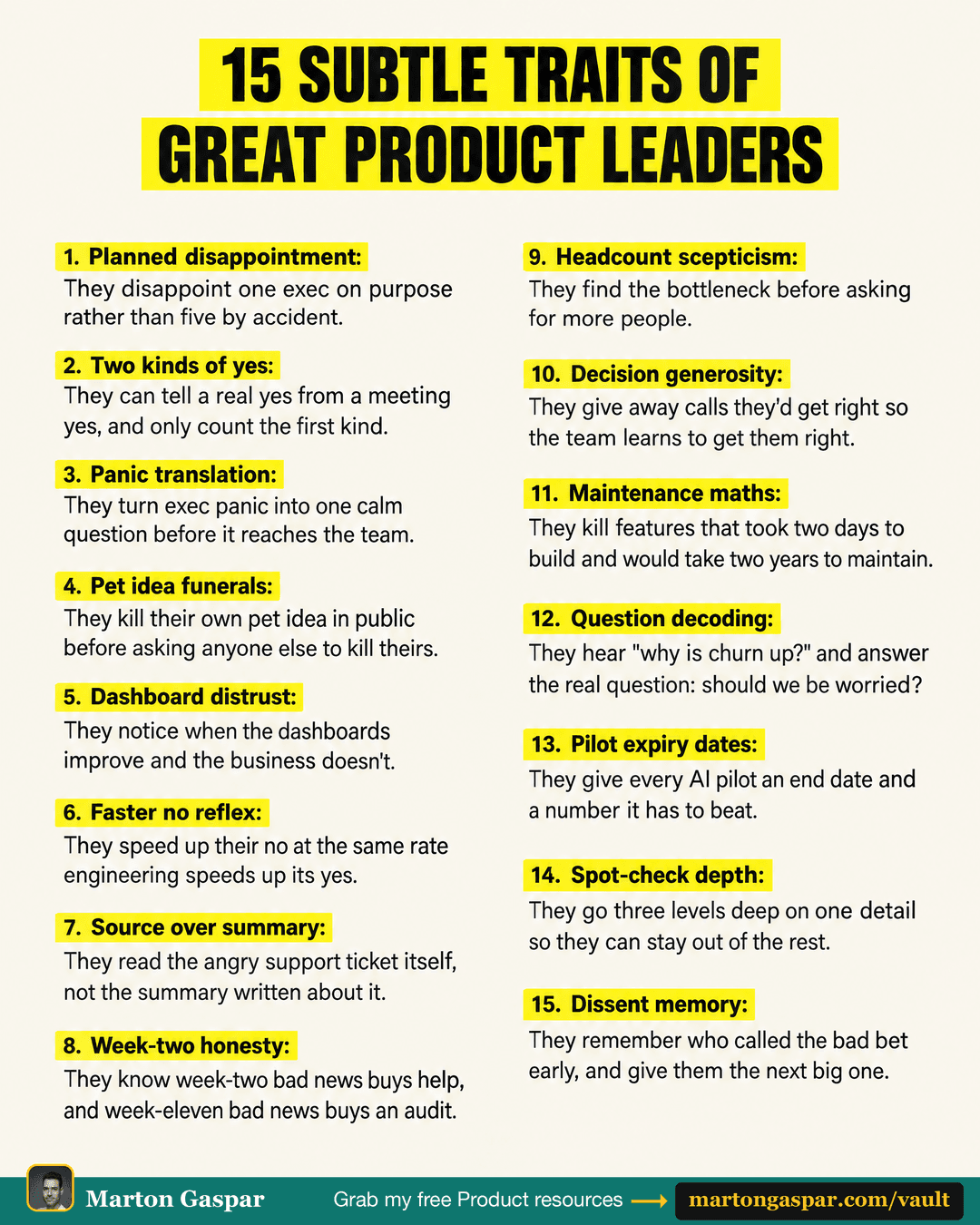
I've coached 100+ product leaders. None of them could name what made them great.
So I mapped them. Fifteen subtle habits, easy to miss from the outside, and they all have the same effect. The team stops waiting on the leader.
That matters more as a team grows. At five engineers, it is normal for every decision to wait for you. At fifty, the same setup means every decision starts routing through one person, and the whole team slows to the speed of one calendar.
Here are the fifteen, grouped by the job they do. Read them as a checklist, and notice which ones you already run.
Saying no without losing the room
The first habit is planned disappointment. The default is to defend your no, which turns it into an argument you have to win. The better move is to show people what their yes would kill, and let them make the call. Great product leaders disappoint one exec on purpose rather than five by accident.
The second is knowing there are two kinds of yes. When someone says yes, ask what they are giving up to back it. If the answer is nothing, you got politeness, not commitment. Great product leaders can tell a real yes from a meeting yes, and they only count the first kind.
The third is a faster no reflex. Decide what a yes needs before the asks arrive. Then a no takes a minute instead of a month. The best leaders speed up their no at the same rate engineering speeds up its yes.
A no you decided in advance is quicker and easier to defend.
Turning pressure into questions
Panic translation comes first here. "Leadership is worried" freezes a team. "Can we check churn by Friday?" moves it. Great product leaders turn exec panic into one calm question before it reaches the team.
Question decoding is the same skill pointed upwards. When someone senior asks "why is churn up?", the real question is usually "should we be worried?" So answer in this order: are we OK, what is the plan, then the chart. The question was never about churn.
Week-two honesty is the third. Bad news ages into blame. Attach a plan and a date, and it reads as competence, not confession. Bad news in week two buys help. Bad news in week eleven buys an audit.
Pressure usually arrives as a feeling. The job is to hand it back as something the team can act on.
Staying close to what is really happening
Dashboard distrust is the first habit. Pair each squad's metric with one it does not control, such as revenue, churn or support volume. When the first moves and the second does not, you are measuring motion, not progress. Great leaders notice when the dashboards improve and the business does not.
Source over summary is the second. Once a week, read five raw tickets yourself. Read the angry support ticket itself, not the summary written about it. Then quote one back in a meeting and watch the team start doing the same without being asked.
Spot-check depth is the third. Pick one detail per review and chase it to the raw data. Going three levels deep on one detail lets you stay out of the rest. That one deep dive sets the bar your team holds itself to when you are not in the room.
You cannot read everything. You can make it clear that anything might get read.
Setting the bar for ideas and bets
Pet idea funerals come first. When you kill your own idea, say out loud what evidence changed your mind. That sentence becomes the bar every other idea gets held to. Kill your own pet idea in public before asking anyone else to kill theirs.
Pilot expiry dates are next. Set the kill number before the pilot starts, while nobody is attached to it. Give every pilot, AI pilots included, an end date and a number it has to beat. A pilot with no end date is not an experiment. It is a subscription.
Maintenance maths is the third. Before any quick win, ask who owns it in month six. The build is the deposit, maintenance is the mortgage. Great leaders kill features that took two days to build and would take two years to maintain.
Dissent memory is the fourth. When you make the bet, write down who disagreed and why. Six months later that note tells you exactly who to trust with the next one. Remember who called the bad bet early, and give them the next big one.
Every one of these sets the rule before anyone is attached to the outcome. Setting it early is what makes it feel fair.
Building a team that does not wait on you
Headcount scepticism is the first. Before you ask for headcount, find what the new person would wait on. If the answer is a decision only you can make, headcount buys a longer queue, not more speed. Find the bottleneck before asking for more people.
Decision generosity is the second. Hand over the call, keep the safety net. Watching you decide only teaches the team to watch you decide. Give away calls you would get right, so the team learns to get them right.
These two habits are where the other thirteen pay off. A team that has seen how you say no, handle pressure and judge evidence can start making those calls itself.
One habit, not fifteen
All fifteen habits point the same way. They move the thinking out of one head and into the team: the bar for evidence, the rules for bets, the way pressure gets handled, the calls themselves.
The payoff is a change in where decisions happen. The team moves at its own speed instead of the speed of one diary.
Check which of the fifteen you already run without thinking. Then pick one you do not, and start it before the team gets big enough to wait.
Download the one-page version and keep it where you plan your week.