There are two kinds of people in every product team right now.
One talks about AI in meetings. One opens it before their first coffee. One sounds fluent. The other is becoming it.
From the outside, they can look like the same person. Both have opinions. Both use the right words. The gap between them doesn't show up in a meeting. It shows up later, in the calls they make when the output in front of them is almost right. That gap is easy to miss, including when it's your own.
The room that talks about it
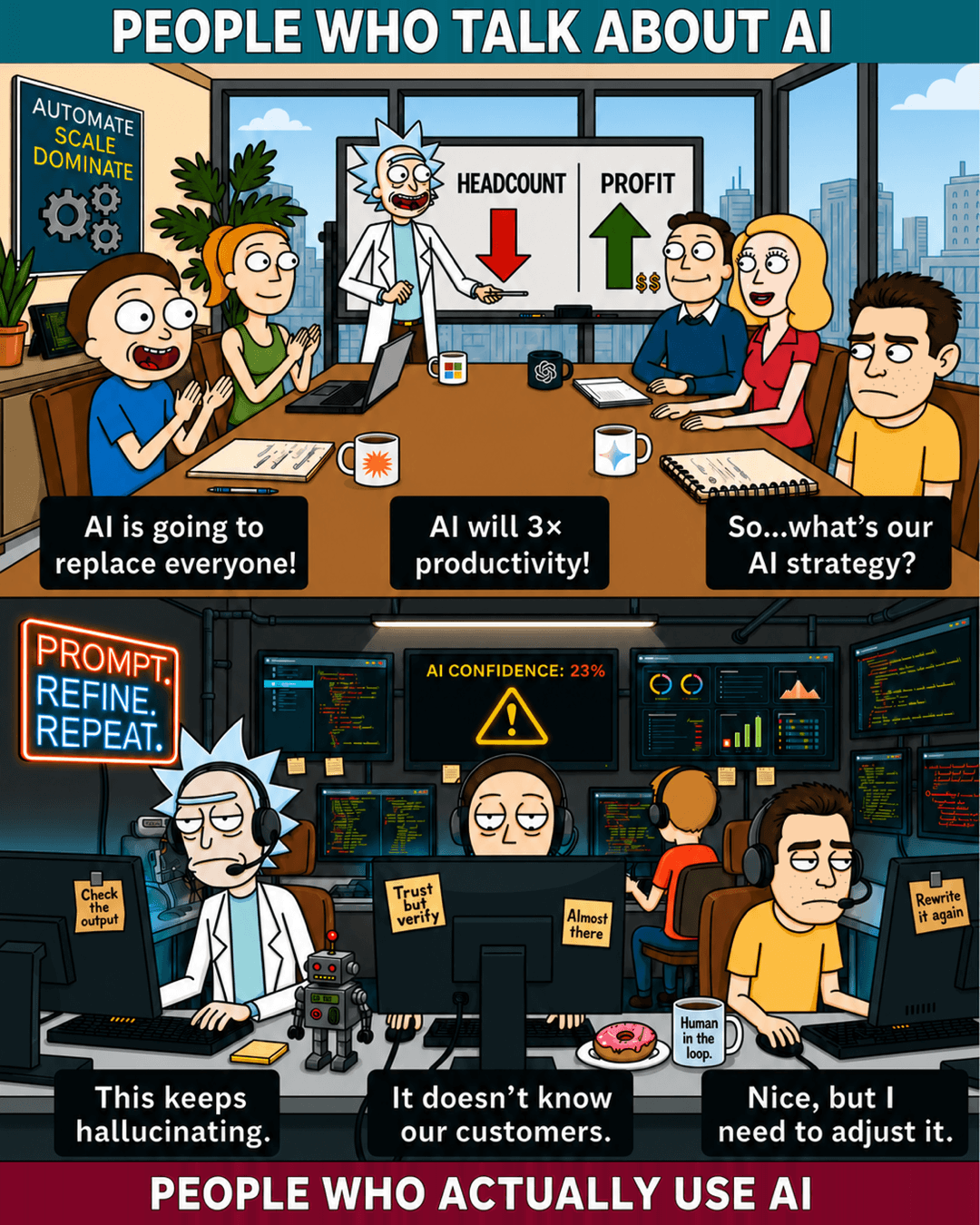
The top half of the picture is the meeting room. A poster on the wall says automate, scale, dominate. The chart on the whiteboard has headcount going down and profit going up. And the lines are ones most teams have heard in some form. "We're all getting replaced." "AI tripled the output." "So do we still need you?"
Confident, loud, and built on nothing they've actually run.
This isn't a character flaw. It's what a lot of operating models reward. Meetings pay out for sounding sure, for having a take, for the bold number on the slide. Nobody in that room is asked what they tried last week and where it broke. So fluency gets mistaken for skill, and the loudest view of AI is often the one with the least contact with it.
A view on a tool and time spent with it are two different things.
The room that uses it
The bottom half is a different room. Headsets on, screens full, sticky notes everywhere: check the output, trust but verify, almost there, rewrite it again. The lines here are different too. "It hallucinates." "It doesn't know our customers." "Nice, but I need to adjust it."
Quieter, slower, and the only place judgement gets built.
These people aren't less excited because they know less. They're less excited because they know more. They've seen where it's right, where it's close, and where it's wrong with total confidence. Every "I need to adjust it" is a small decision about what to keep, what to change and what to throw away. Do that often enough and you have something the meeting room doesn't: a feel for when the output can be trusted.
The slower room looks less impressive and learns more per week.
Judgement is built in the doing
You don't build it from the sidelines. The real skill is knowing when to trust it and when to step in yourself.
That skill has no shortcut. You can't pick it up from a keynote, a thread or a strategy deck, because it's made of specific moments: a summary that misses the customer who mattered most, a draft that looks finished and frames the wrong problem, an answer that was right when you expected it to be wrong. Each one teaches you where the line sits for your product, your customers and your team.
That's also why the gap is hard to see from outside. Two people can say the same words about AI in a meeting. Only one of them has the reps behind the words.
If you want to know which room you spend your week in, look at what you actually did with AI in the last few days, not what you said about it.
What stays with the product person
I build with a product team of AI agents every day. The tools do the building. What's worth building, and what to trust, is still my call.
That split is the whole point. The more work the tools take on, the more the job moves towards two questions: is this worth doing at all, and is this output good enough to act on? Neither question gets easier with a better model. Both get easier with more time in the slower room.
So the useful move for a product team is fewer rounds of talk about AI strategy and more people with hands on real work, making small calls about what to trust, and saying out loud where it broke. Hands-on use is how the talking room turns into the doing room.
Hands on the work beats opinions about the work.
Everyone gets the same model
Here is the one idea under both rooms. Everyone gets the same model. Judgement is the only thing AI can't hand you.
The tools are open to every team. What nobody can buy with them is the feel for when to trust them. That only comes from use, and it builds up slowly, one adjusted draft at a time.
A companion piece looks at where product managers stop with AI once they're in the slower room, and the level above it. This one is about getting into that room in the first place.
A simple self-check to finish. Over the last week, did you spend more time talking about AI or using it on real work? And when you used it, can you name one moment where you decided not to trust the output, and why? If you can, you're building judgement. If you can't, that's the gap to close first.
Download the one-page version and keep it where you'll see it before your next meeting about AI.