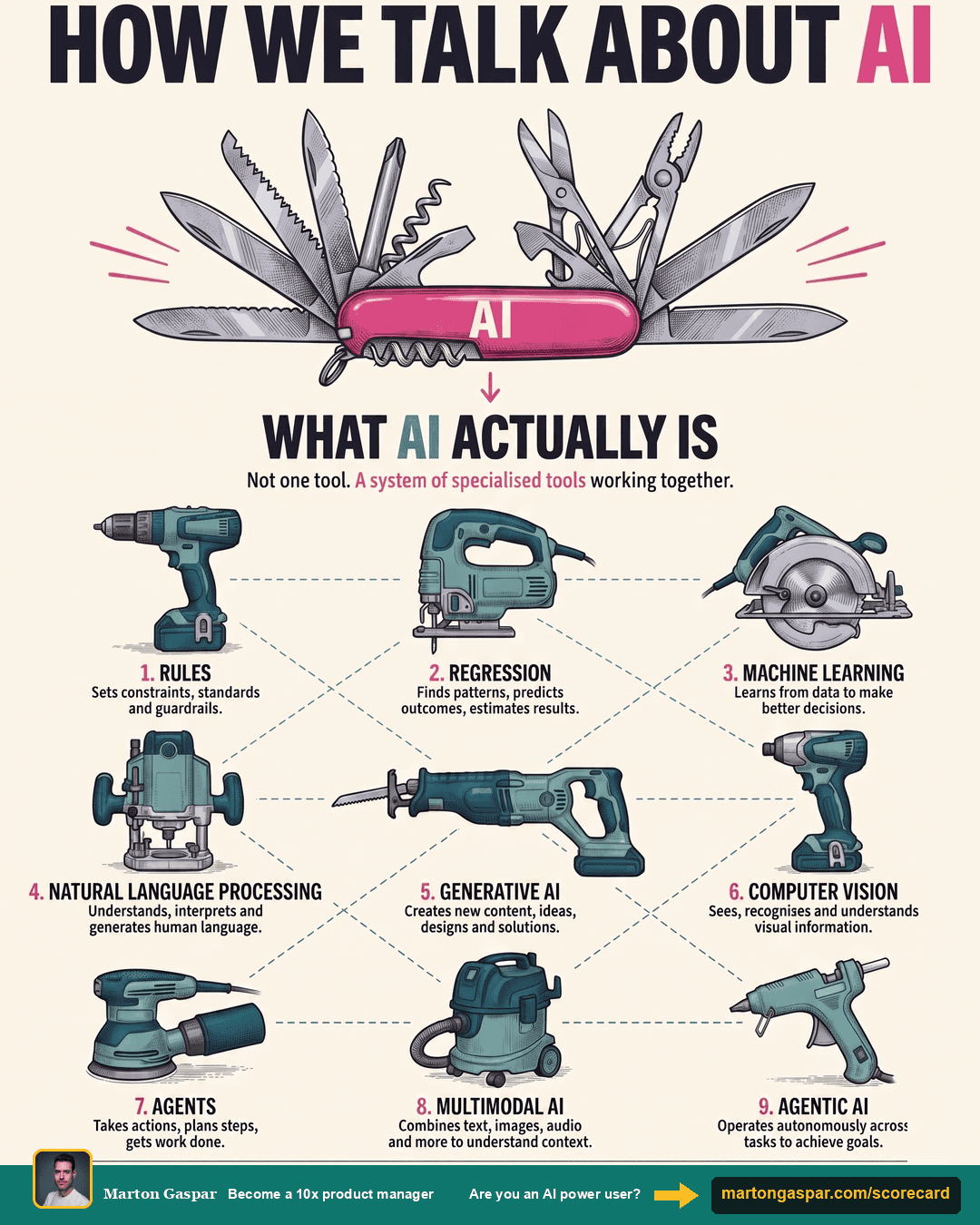
Product managers don't need all of AI. You need the parts that move your product.
The way AI gets talked about makes it sound like one thing. One tool, one skill, one wave you are either riding or missing. In practice it is a set of specialised tools that do very different jobs, and most products only need a few of them.
I work backwards in my own products. Start from the problem, then pick the tool. That order matters, because when you start from the tool you end up looking for a problem it can solve, and the roadmap fills up with things that are interesting to build and hard to justify.
Below are the nine types of AI you are likely to hear about, what each one does, and a concrete example of where a product team might use it.
Rules engine
A rules engine is if this, then that. There is no model and no data needed. You write the logic, and it runs the same way every time.
Think: who gets the trial extension and who doesn't. If the logic can be written down and agreed, a rule is often the cheapest, clearest and easiest thing to explain to a stakeholder. It belongs on the list because it is the option people forget to check before reaching for something heavier.
Regression
Regression finds how one number moves another. It is the tool for questions about relationships between things you already measure.
Think: which onboarding step actually predicts month-two retention. That is a product question with a real decision attached. If one step predicts retention and the others don't, you know where to spend the next sprint.
Machine learning
Machine learning learns patterns from your data and scores what happens next. Where regression explains a relationship, machine learning is usually put to work predicting, account by account or event by event.
Think: a churn score on every account, refreshed weekly. The value is in what the team does with the score, so the product question comes first. Who acts on it, and what do they do differently?
Natural language processing
Natural language processing reads and writes language at volume. It is the tool for any job where a person currently reads a lot of text and sorts it.
Think: every support ticket tagged and routed before a human opens it. The human still handles the ticket. The sorting stops eating their morning.
Computer vision
Computer vision reads images and video. If your users currently type in information that already exists in a picture, it is worth a look.
Think: a user photographs their ID and your signup form fills itself. Fewer fields, fewer typos, fewer people giving up halfway through.
Generative AI
Generative AI creates new content from a prompt. It is the type most people mean when they say AI today, which is exactly why it gets reached for first.
Think: the first draft of the spec, the release note, the test data. The word that matters is first. It gives you a draft to react to, and the judgement about what goes out stays with you.
Agents
Agents run one defined task end to end. You set the task, the agent works through the steps, and you get the result.
Think: the competitor sweep you keep meaning to do on Mondays. The task is clear, repeatable and easy to check, which is what makes it a good fit.
Multimodal AI
Multimodal AI handles text, images, audio and numbers together. It is useful when the meaning sits across more than one kind of input at once.
Think: a user interview where it hears the answer and sees where they got stuck. What someone says and what they do on screen are two different signals, and a lot of discovery lives in the gap between them.
Agentic AI
Agentic AI picks the steps and coordinates the tools to hit a goal you set. Where an agent runs one defined task, agentic AI decides how to reach the outcome.
Think: tier-one support resolved end to end, with the odd ones escalated. The goal is yours to set. So is the line for what gets escalated to a person.
Start from the outcome you are judged on
Nine on the list. Two or three will move your product. You are not behind on the other six.
That is the part worth holding on to. The pressure to keep up with every type of AI is real, and it pulls attention away from the work that matters to your career: making good calls about what to build. A product manager who knows exactly which two tools move their outcome is in a stronger position than one who has a shallow grip on all nine.
So take the outcome you are judged on this quarter and ask which of the nine would move it. Learn those. The rest can wait, including the tenth when it arrives.
If AI tools keep arriving as the answer before anyone has named the problem, Product Strategy Starts With the Problem, Not the Tool (/vault/product-strategy-starts-with-the-problem) covers that side of it.
If you want to know where AI fits in your own work, the free assessment at martongaspar.com/scorecard is a quick place to start.