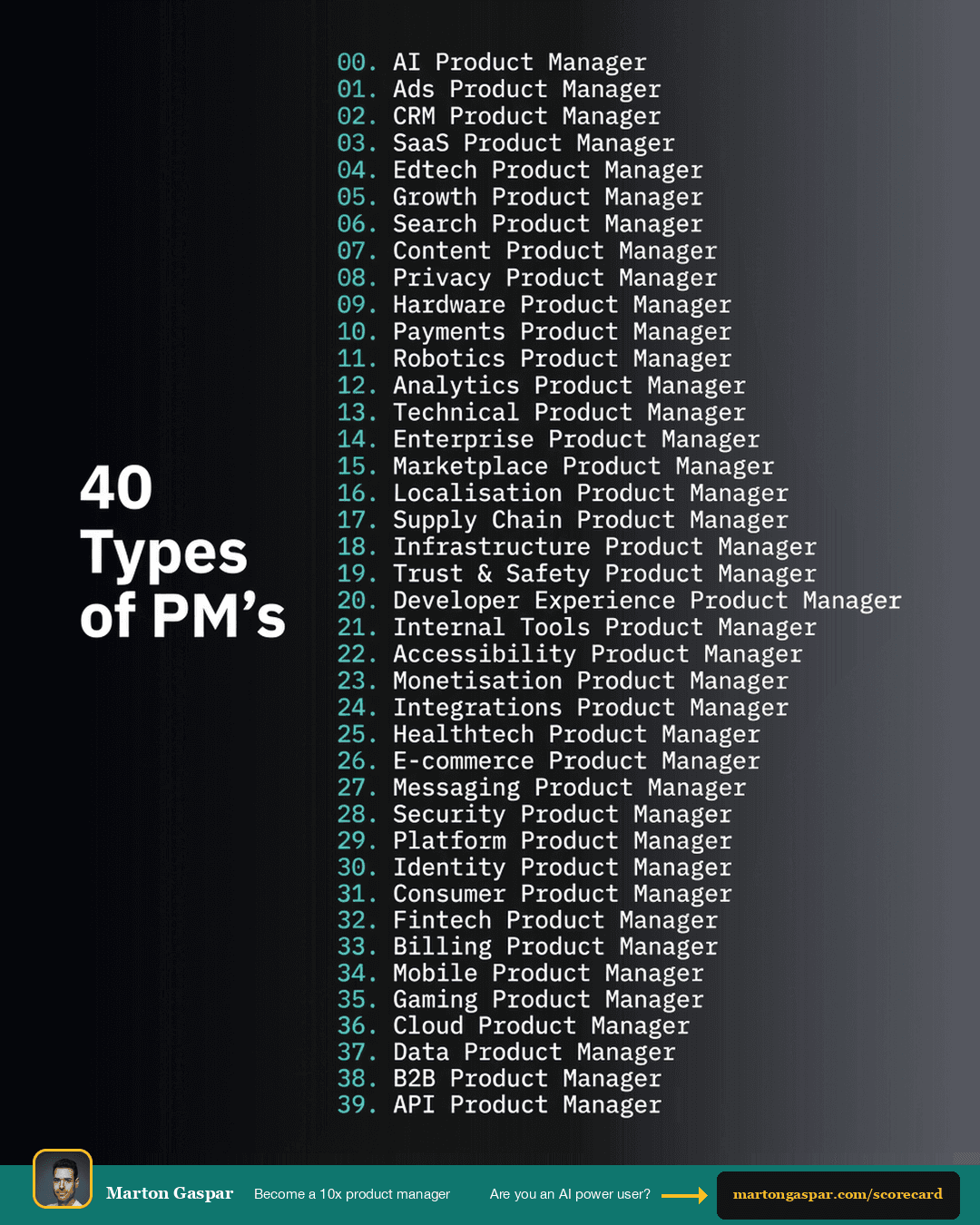
"Product manager" isn't one job. It's 40.
Most PMs stay in one lane their whole career. Nobody tells them to. The system just rewards it, and after a few years the lane starts to feel like the job itself.
Below are 40 product manager jobs, grouped by what shapes the work. Read them as a map. Then look at the lane you're in, and the one you could cross into next.
Lanes shaped by the market you serve
Some product jobs are defined by who the customer is and what industry they work in. The craft is the same, but the buyers, the rules and the pace of change are not.
In this group: SaaS Product Manager, Enterprise Product Manager, B2B Product Manager, Consumer Product Manager, Marketplace Product Manager, E-commerce Product Manager, Fintech Product Manager, Healthtech Product Manager, Edtech Product Manager, Gaming Product Manager, Supply Chain Product Manager, Hardware Product Manager and Robotics Product Manager.
These lanes build deep knowledge of one market. That depth is valuable, and it's also why moving between them can feel bigger than it is.
Lanes shaped by money and growth
Other product jobs are defined by a number the business depends on. The work sits close to revenue, and the feedback loop is often fast.
In this group: Growth Product Manager, Monetisation Product Manager, Ads Product Manager, Payments Product Manager, Billing Product Manager and CRM Product Manager.
Lanes shaped by platform and technology
A large group of product jobs serve other teams and other systems as much as end customers. The users might be developers, internal staff or other products.
In this group: Technical Product Manager, Platform Product Manager, Infrastructure Product Manager, Cloud Product Manager, API Product Manager, Integrations Product Manager, Developer Experience Product Manager, Internal Tools Product Manager, Data Product Manager, Analytics Product Manager and AI Product Manager.
Lanes shaped by trust and access
Some product jobs exist to make sure the product is safe, fair and usable by everyone it is meant for.
In this group: Privacy Product Manager, Security Product Manager, Identity Product Manager, Trust & Safety Product Manager, Accessibility Product Manager and Localisation Product Manager.
Lanes shaped by a surface or experience
The last group is defined by a part of the product people use every day.
In this group: Search Product Manager, Content Product Manager, Messaging Product Manager and Mobile Product Manager.
That's 40 jobs under one title. Each one asks for the same core judgement, applied to a different set of customers, constraints and numbers.
Nobody tells you to stay in one lane
There's no rule that says a payments PM has to stay in payments, or that a growth PM can never run a platform. The pull to stay comes from somewhere less visible.
Recruiters hire what they know. When a role opens, the safest-looking CV is the one that has already done this exact job. Your referrals live in the same world too. The people who know your work best tend to work in your lane, so the opportunities they pass on look a lot like the job you already have.
None of this is a decision anyone makes on purpose. It's how the system works by default. Left alone, it keeps you where you are.
What a second lane does to your profile
Add a second lane and your profile becomes something most PMs can't replicate.
A PM who has worked in both growth and platform, or both fintech and trust and safety, brings a combination that is hard to find. They can see problems from two sides, and they've already shown they can learn a new domain and still do the core job well.
That's rare. And rare gives you options. It widens the roles you're credible for, and it gives you a story about your judgement that a single lane can't tell.
If you want a different way to read the same question, two other pieces cover nearby ground. /vault/types-of-product-managers looks at six product contexts and the different job each one hands you. /vault/generalist-vs-specialist-product-manager looks at which deciding skills get paid most.
Which lane next?
Start with the lane you're in right now. Then look across the list for the one that sits next to it: the lane that shares your customers, your numbers or your systems, but asks you to learn something new.
That's usually the easiest second lane to cross into, and the one that makes the first more valuable.
If you want to see where you actually stand as a PM, the free scorecard is at martongaspar.com/scorecard.