You didn't lose your edge. You got a different job.
A product manager can do great work on one product, move to the next, and find that nothing clicks. Same skills, same person, different results. The easy story is that something went wrong with you. The more useful story is that the product changed the job.
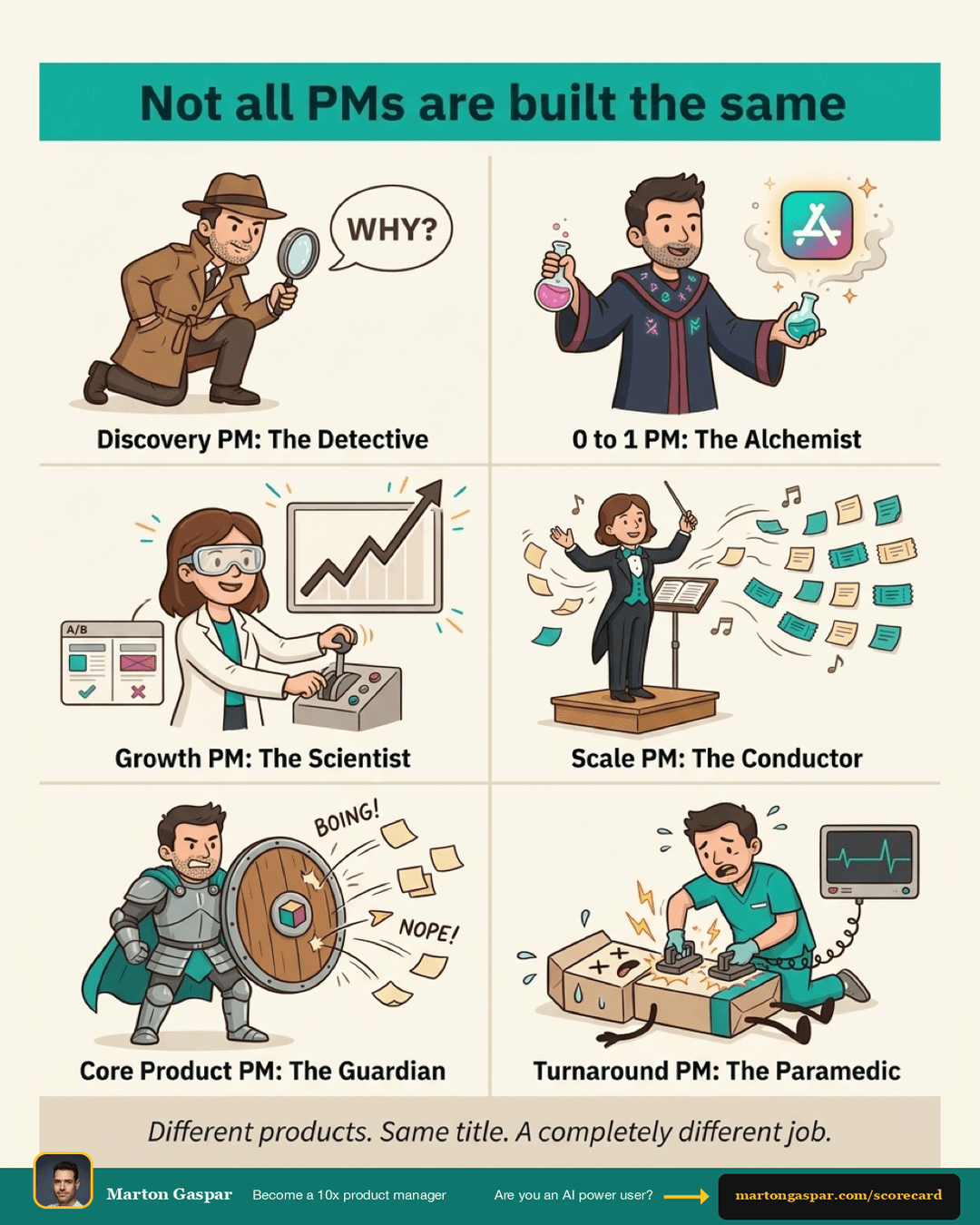
There are six very different product manager jobs hiding behind one title, and the title rarely tells you which one you're in. Know which one it is, or spend the quarter being judged on the wrong one.
If you've read the PM archetypes piece in the Vault, this is its companion. That one names four modes a product manager works in: Operator, Builder, Optimiser and Strategist. This one looks at six product contexts: the situation the product is in, and the job that situation hands you. Read them together.
Discovery PM: the Detective
Everyone arrives with a solution and wants it built yesterday. The default is to take the request and ship it, because that feels like progress.
The Detective holds the line. They strip the request back to what the customer is actually doing, and they refuse to build until the real problem has a name. The skill here is patience under pressure: asking why one more time when the room wants a date.
In discovery, naming the problem is the job. Building comes second.
0 to 1 PM: the Alchemist
You start with a hunch, a blank page and almost no data. The trap is to fake certainty: a confident plan and numbers nobody can back.
The Alchemist builds conviction without pretending certainty. They turn the idea into something customers choose, before time, money or belief runs out. Every week is a race between learning and running out of road.
At 0 to 1, conviction is the job. False certainty is the risk.
Growth PM: the Scientist
The dashboard celebrates every spike. The default is to take the win, repeat whatever seemed to cause it, and move on.
The Scientist works out whether the spike came from real behaviour change or from noise, seasonality and luck. Then they tell the room which one it was, even when the room wanted the good version, and they scale only what holds up.
In growth, the job is telling signal from noise, out loud.
Scale PM: the Conductor
Growth has turned yesterday's shortcuts into today's constraints. The default is to keep adding features on top of foundations that are starting to creak.
The Conductor decides what must change, what cannot stop, and how to sequence the rebuild while customers and teams keep moving. Most of the work is about order: what goes first, what waits, and who needs to know.
At scale, sequencing is the strategy.
Core Product PM: the Guardian
Customers have built habits, workflows and businesses on what you own. Every change risks breaking something they've built their day around. One trap is freezing. The other is moving as if nobody depends on you.
The Guardian moves anyway. Carefully. They know who relies on what, they change things in steps people can absorb, and they treat trust as part of the product.
On a core product, careful change is still change. Standing still is a choice too.
Turnaround PM: the Paramedic
You show up to falling metrics, years of shortcuts, and a team that's heard every rescue plan before. The default is a big new strategy deck, which the team has also seen before.
The Paramedic stabilises what's bleeding, decides what can wait, and earns just enough trust for people to believe this time's different. Small, visible fixes come before the grand plan.
In a turnaround, trust is the first thing you rebuild.
Same skills, a different job
You can be brilliant at one of these and lost in the next. Same skills, same you. The job changed under you.
No type has it easier. They're just different jobs. The Detective's patience can look slow in a turnaround. The Paramedic's urgency can look reckless on a core product people rely on. The Scientist's caution can starve a 0 to 1 bet that needs conviction.
So when the results stop coming, check the context before you question yourself. Ask what the product needs right now, which of the six jobs that is, and whether you're still doing the last one.
You were never losing your edge. The product was just asking for a different one.
Download the one-page version and keep it where you plan, so the next time the job shifts under you, you can name it.