Nobody fights harder to keep a great PM. Nobody can explain what makes them great.
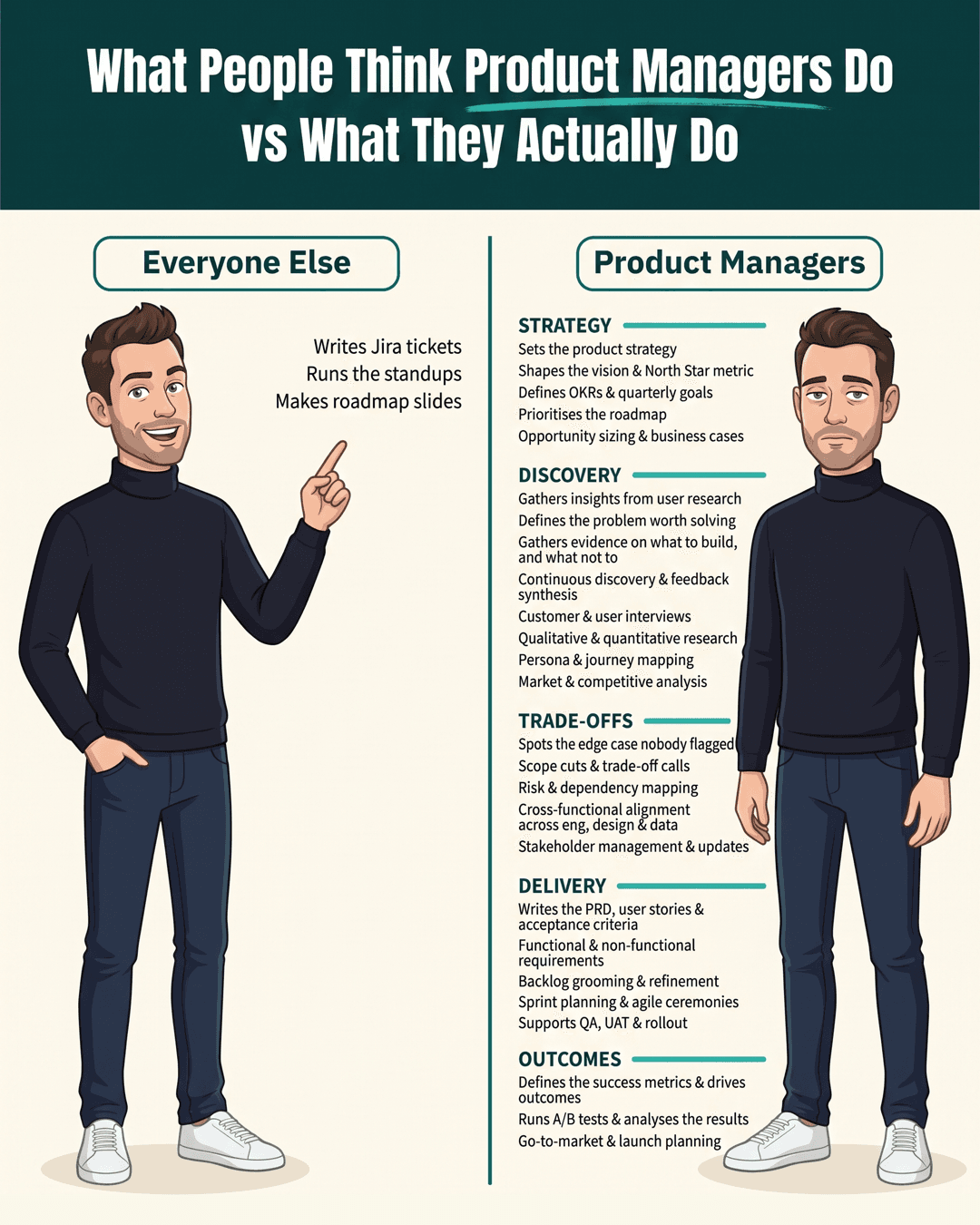
Ask around and you get one of two answers. The short list: writes Jira tickets, runs the standups, makes roadmap slides. Or the long list: strategy, discovery, trade-offs, delivery, outcomes, with a dozen jobs under each heading.
The short list is the insult. The long list is the truth. But even the truth doesn't explain what makes the best ones impossible to replace. That part sits behind the list, and it's worth walking through both before we get to it.
The short list everyone else sees
From the outside, product management looks like admin. Tickets, standups, slides. The visible parts of the week.
That view isn't malicious. Those are simply the only parts of the job that leave a trail other people can see. The thinking that decides what goes into the ticket happens somewhere else, often before anyone else is in the room.
If the short list were the job, anyone organised could do it. It isn't, and they can't.
Strategy and discovery: deciding what is worth building
The long list starts before any work is planned. On strategy, a product manager sets the product strategy, shapes the vision and the North Star metric, defines OKRs and quarterly goals, prioritises the roadmap, and sizes the opportunity with a business case behind it.
Discovery is where that strategy gets tested against real people. Gathering insight from user research. Defining the problem worth solving. Gathering evidence on what to build, and what not to. Running continuous discovery and pulling the feedback together. Customer interviews, qualitative and quantitative research, persona and journey mapping, market and competitive analysis.
None of this shows up on a slide until it's already been decided, which is exactly why the short list misses it.
Trade-offs, delivery and outcomes: making it real and making it count
Then the work gets harder, because resources are finite. Trade-offs means spotting the edge case nobody flagged, making scope cuts, mapping risks and dependencies, aligning engineering, design and data, and keeping stakeholders updated.
Delivery is the part people do see: writing the PRD, user stories and acceptance criteria, the functional and non-functional requirements, backlog refinement, sprint planning, supporting QA, UAT and the rollout.
Outcomes close the loop. Defining the success metrics and driving towards them, running A/B tests and reading the results, planning the launch and the go-to-market.
That's the truth of the role. It's also still not the answer.
Where product theatre starts
In the teams I've led, and in years of coaching product managers, product theatre starts the same way. Work keeps going. Nobody asks why. Nobody knows what would change the plan.
The task survived. The decision it was meant to serve disappeared.
This is the trap inside the long list. You can do every item on it, well, and still be running a busy team that isn't deciding anything. The list describes activity. It says nothing about whether the activity still points at a choice someone needs to make.
A full calendar is not proof of a live decision.
Great PMs manage the decisions behind the list
Great PMs do not manage the list. They manage the decisions behind it. If a task cannot name one, it does not belong.
So here's the test. Before any task starts, name four things. The decision it serves. Who owns that decision. What evidence could change it. What happens next, once the evidence is in.
A list that cannot answer these is not a plan. It is theatre.
This is also where seniority actually comes from. Carrying more of the list doesn't make you more senior. Improving the decisions behind it does. A quick self-check: pick three tasks on your team's board right now and see which ones can answer all four.
The PMs people fight to keep
Some PMs leave and people fight to keep them. The work is not why. They made people feel safe to say the hard thing. To push back. To tell the truth.
That is what the team misses when they're gone.
I learned how easy it is to get this wrong. At one of my startups I ran a performance review and asked an engineer how our CTO was doing. "He's good, right?"
He said yes.
I still do not know what he came in to tell me. I closed the door with one leading question. That is one conversation. One door closed. There were others.
A decision is only as good as the warnings that reach it in time.
Three habits that make pushback safe
Start with your last five big decisions. Who argued with you? Who warned you in time? If nobody comes to mind, that is your answer, and it's worth sitting with before the next one.
Then ask the question without your answer in it. "How is she doing?" not "She's doing well, right?" Then stop talking. The pause after the question is where the truth sits.
Finally, tell people what their pushback changed. The decision, the scope, or how sure you are. If nothing changed, say why. People stop arguing when arguing changes nothing.
I get this wrong too. I stay calm when the big thing cannot change. I lose it when the small thing still can. Whoever can trigger you gets to steer you.
Not the tasks they own, the decisions they protect
Put the two halves together and you get the answer the lists miss. A great product manager keeps every task tied to a real decision, and keeps the room safe enough that the evidence and the warnings about that decision actually arrive.
That is what makes a great PM irreplaceable. Not the tasks they own. The decisions they protect.
AI can make you better at the work. It cannot make you better to work with.
Download the one-page version and keep it next to your team's board.