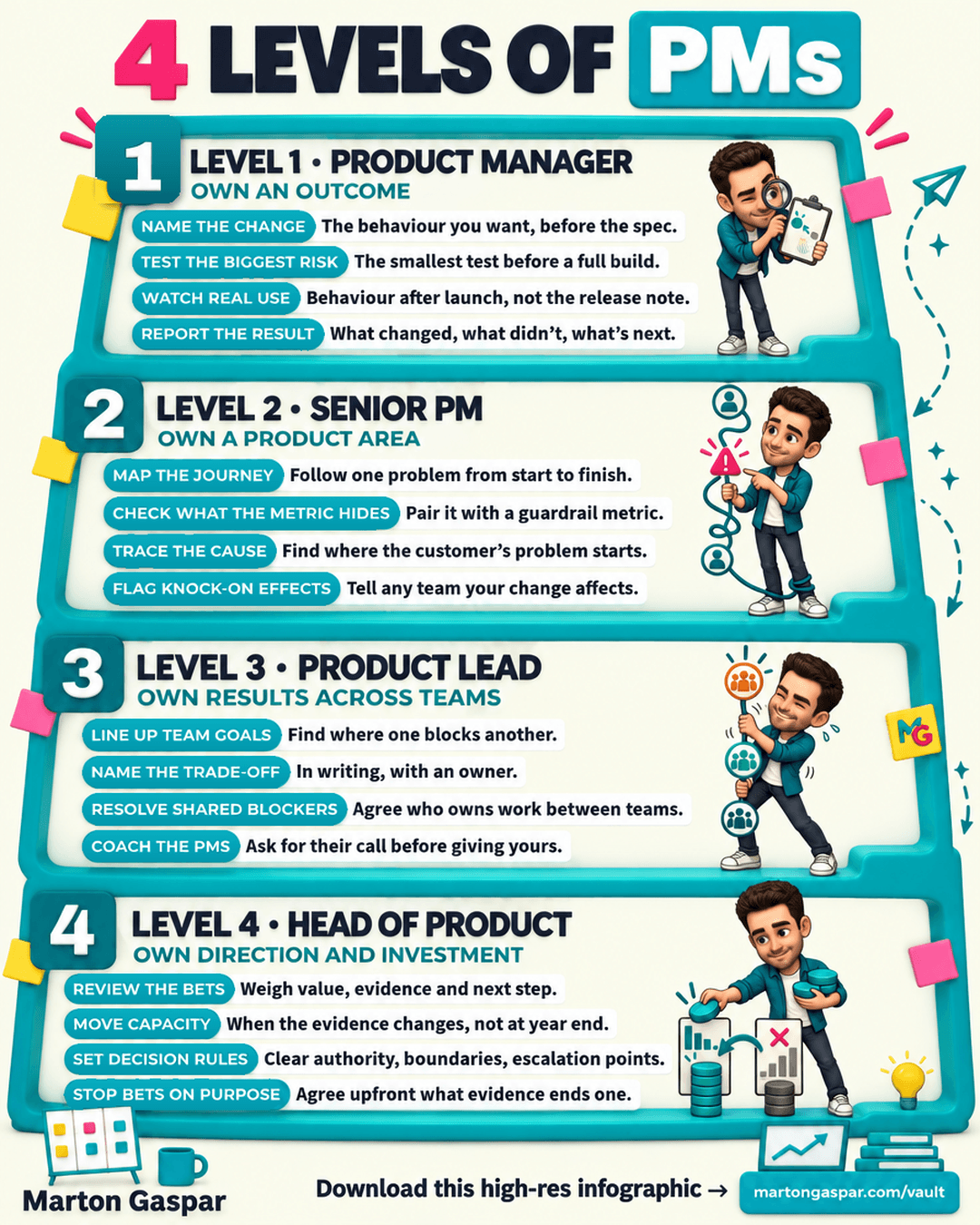
The higher you go in product, the less your metric is the win.
If you're hitting your target and it still doesn't feel like a win, you may have the wrong definition. It is not a performance problem but a definition problem. The definition of winning changes as the scope grows, and the habits that earned the last level can point the wrong way at the next one.
Here is how you win at each level. One note before the list: these are not titles. They are scopes. You may already be operating across more than one. A Senior PM can be doing Product Lead work on a problem that cuts across teams, for example.
Product Manager: the outcome moved, not "it shipped"
At this scope you own an outcome. The win is the outcome moving, not the feature going live.
Take one feature and map it:
Customer action before.
Behaviour changed.
Outcome after.
If only behaviour changed but the outcome didn't, you proved usage. People used the thing. That's worth knowing, but it isn't the win. The win is the outcome increasing after release.
The habits that support this: name the change you want before the spec, test the biggest risk with the smallest test, watch real use after launch rather than the release note, and report what changed, what didn't, and what's next.
Senior PM: the area got better, not "my metric rose"
At this scope you own a product area. One metric going up while others fall is not a win for the area.
Take your main target and ask:
Who pays if your metric rises?
What breaks first?
When do we stop and call it a loss?
Then agree one guardrail with the affected team and set a limit on it. The guardrail is the number you protect while chasing the main one, and agreeing it with the team that would feel the damage makes it real.
The win is the whole area improving, not one metric up while others fall. It helps to follow one problem from start to finish, check what the metric hides, trace where the customer's problem starts, and tell any team your change affects.
Product Lead: the teams add up, not "each team hit target"
At this scope you own results across teams. Every team hitting its own target is not the same as the teams adding up.
Put two clashing targets side by side and write this sentence: "Both teams could hit their own targets and the customer would still lose."
If that sentence is true, fix the cause:
Priorities: resequence.
Ownership: assign.
Capacity: move or cut.
The win is the teams adding up. That means lining up team goals to find where one blocks another, naming the trade-off in writing with an owner, agreeing who owns work between teams, and coaching the PMs by asking for their call before giving yours.
Head of Product: money on the right bets, not "the bets delivered"
At this scope you own direction and investment. A bet that delivered on time can still be the wrong bet.
Take your biggest active bet. Ask:
What evidence is keeping it funded?
What would change your mind on it?
Who owns the call to stop it?
If you cannot answer all three, the bet is running on assumption. The win is money on the right bets, which means reviewing bets on value, evidence and next step, moving capacity when the evidence changes rather than at year end, setting clear decision rules, and stopping bets on purpose by agreeing upfront what evidence ends one.
Why the definition of winning changes with scope
Read the four levels together and a pattern shows. Each step up adds more people who can be affected when your part succeeds.
At Product Manager scope, the risk is mistaking usage for an outcome. At Senior PM scope, it is one metric rising while the rest of the area suffers. At Product Lead scope, it is every team winning on paper while the customer loses. At Head of Product scope, it is bets delivering on time while the money sits on the wrong ones.
The trap at each step is carrying the previous definition up a level. A habit that earned a promotion, such as hitting your own metric hard, can work against you once your scope includes the teams and metrics around it. So hitting a target can feel empty. The target measures the old scope, and the work has moved to a new one.
Apply it to your own target
Each level asks a wider version of the same question: what does success look like beyond my own piece of the work?
Now apply it to your own target. Finish this sentence: "We could reach this and still fail if…"
What still fails when your part succeeds? Whatever goes in that blank is the edge of your current definition of winning, and often a sign of the next scope.
Which level just described exactly where you are? For a different angle on the same ladder, built around the one question you own at each stage, see /vault/pm-levels.