A lot of product managers step back from AI right as it starts to pay off.
Nobody calls it quitting. It feels more like reaching a verdict. You put it on real work, you saw where it breaks, and you filed it under "useful for some things". You don't quit. You conclude. That's the trap.
The trouble is where the conclusion gets drawn. AI has three levels of useful, and most people only ever see two. The second one feels like the end of the road, so it's where the learning stops. Here are all three, what each looks like from the inside, and a quick check for where your own work sits.
Level one: amazed
The first level is the excitement phase. Everything looks automatable. The roadmap writes itself.
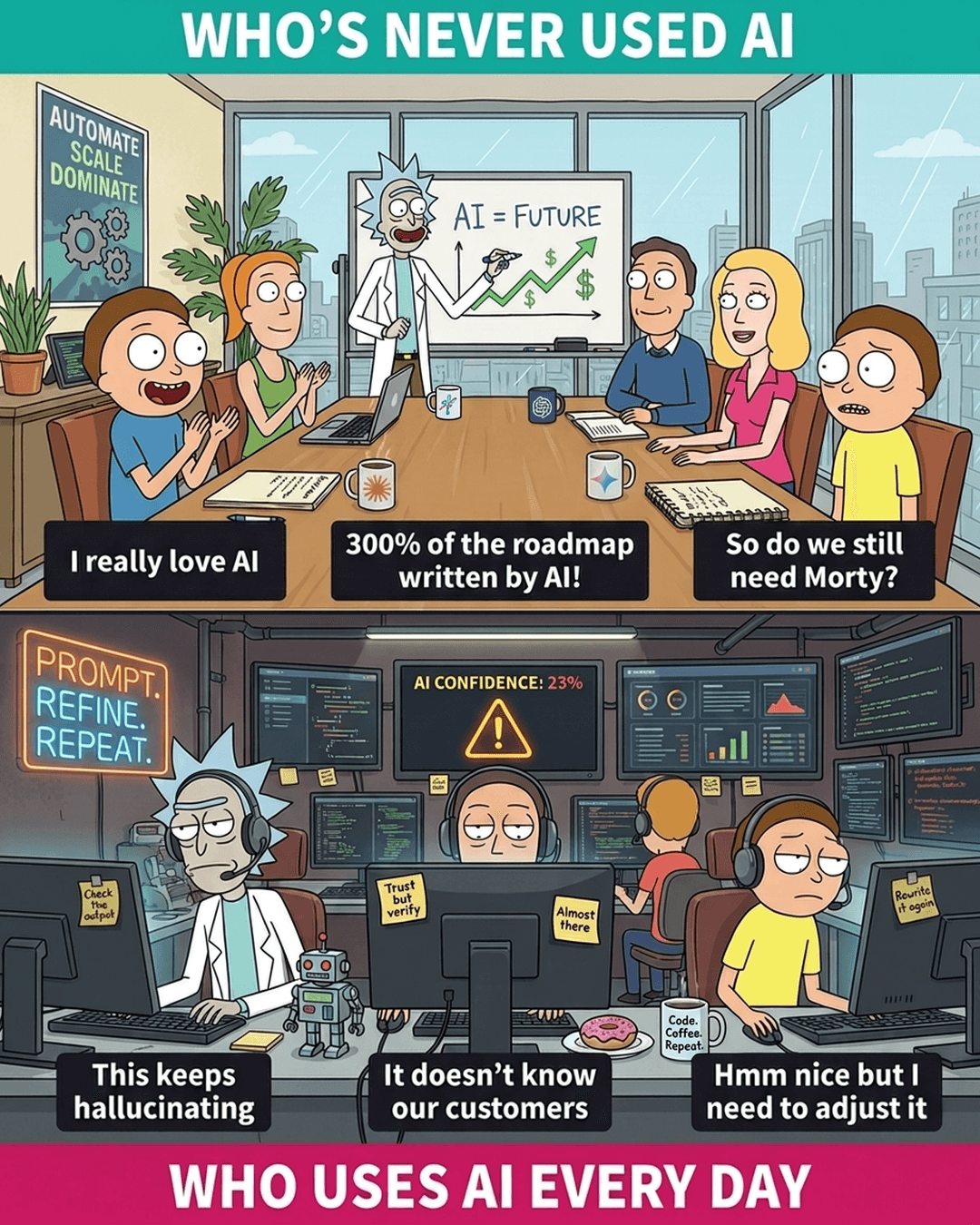
The top half of the meme is this room. A poster on the wall that says automate, scale, dominate. A whiteboard that says AI equals future. Someone cheering that 300% of the roadmap was written by AI. Someone even asks, out loud, whether the team still needs its most junior person.
This level runs on what AI could do, not on what it has done on your own work. The ideas are big because nothing has been tested yet. That's fine as a starting point. The risk is the big calls getting made in this room, on headcount, on the roadmap, on promises to leadership, before anyone has put the tool against a real customer problem.
Excitement is a fine place to start and a poor place to plan from.
Level two: annoyed
Then you actually use it. On discovery, on a roadmap, on the customer calls. And you learn exactly where it breaks.
The bottom half of the meme is that room. Same people, months in, headsets on, sticky notes on every screen: check the output, trust but verify, almost there, rewrite it again. The captions are lines anyone who uses it daily has said. This keeps hallucinating. It doesn't know our customers. Hmm, nice, but I need to adjust it.
It looks like a downgrade. It isn't. These are the people who now know exactly what it gets wrong, and exactly where it will still lie to them with total confidence. That knowledge is hard to get. You can't read your way to it. You get it by putting the tool on real work and watching it fail in specific ways.
That precision is a level, not a complaint. It's the first point where you can see the tool clearly.
Why the second level feels like the end
Here is the catch. Level two comes with a ready-made conclusion. You've found the limits, the limits are real, so the sensible move seems to be to use it for the easy stuff and keep the important work for yourself.
Level two is where a lot of people stop and call it done. It rarely feels like stopping. It feels like good sense. The hype was wrong, the doubts were right, and the matter is settled.
The problem is that the list of failures gets treated as the finish line, when it's the raw material for the next level. Knowing exactly what the tool gets wrong is only worth something if you do something with that knowledge.
A clear view of the limits is where the real work starts.
Level three: building past it
The level above looks different. You stop fighting the failures. You build around them. Week by week, they cost you less.
In practice, the things that kept going wrong at level two get designed out. If it doesn't know your customers, you give it your customers, in a form it can use every time. If it hands you a wall of text when you needed a decision, you change what you ask it for and what it gets to work from.
When it works, it looks like this. Ten customer calls turn into knowledge you can reuse, instead of ten sets of notes nobody opens again. Every roadmap starts with your context instead of a blank page. Sixty pages of output arrive as three decisions you can actually argue with.
I spent about a year building that system. It does the keeping-up for me now.
All three examples point the same way. The output stops being text you have to check and starts being input to a call you have to make. The judgement stays with you. What changes is how much of the grunt work reaches it already sorted.
The piece on why you should rebuild the product manager job, not just do it faster, goes further on building past the limits. The short version: level three is about building so the same failure stops costing you twice.
The level the meme never drew
That level isn't in the picture. The meme only has two panels. The one worth being in was never drawn.
The missing panel is why the third level is easy to miss. Both rooms you can see are real, and it's natural to assume they're the whole story: the excited room that hasn't used it, and the tired room that has. The third room is slower to show up in anyone's feed, because what it produces is better decisions, not louder claims.
So don't count how often you use AI. Frequency tells you very little. Look at the last three things you used it on, and ask one question of each: did the output change the decision, or just save you the typing?
If it saved you the typing, that's useful, and it's level two. If it changed what you decided, or how well you could defend the call, you're building past it. If you get a mix, that tells you exactly where the next bit of building should go.
Download the one-page version and keep it next to the work you'll put AI on this week.