Your CEO thinks AI can do your job. And for one ugly second, you're afraid they're right.
It writes the spec. It runs the analysis. It builds the prototype. It summarises 200 customer calls before you've finished your coffee. Put those side by side and a fair question follows: so what's left that's actually yours?
It can start to feel like the year "product manager" turns into a line item on someone's cost sheet. That fear is worth looking at properly, because the answer to it is sitting in the very meeting where the CEO asks for AI.
The outputs were never the whole job
The trap is measuring your value by the things you produce. Specs, analysis, prototypes, call summaries. If that is the job, then a tool that makes them faster really does look like a replacement.
The better move is to look at what those outputs were for. A spec was a decision written down. An analysis was a question someone needed answered. A summary of customer calls was a way to work out which problem mattered. The documents were the visible part. The decisions behind them were the work.
When a tool takes over the visible part, what's left is the part that was always the job.
"We need AI." AI to do what?
Then the CEO pounds the table. We need AI.
AI to do what?
The room gets loud. Then quiet. Then someone says "let's take that offline."
Not because they're stupid.
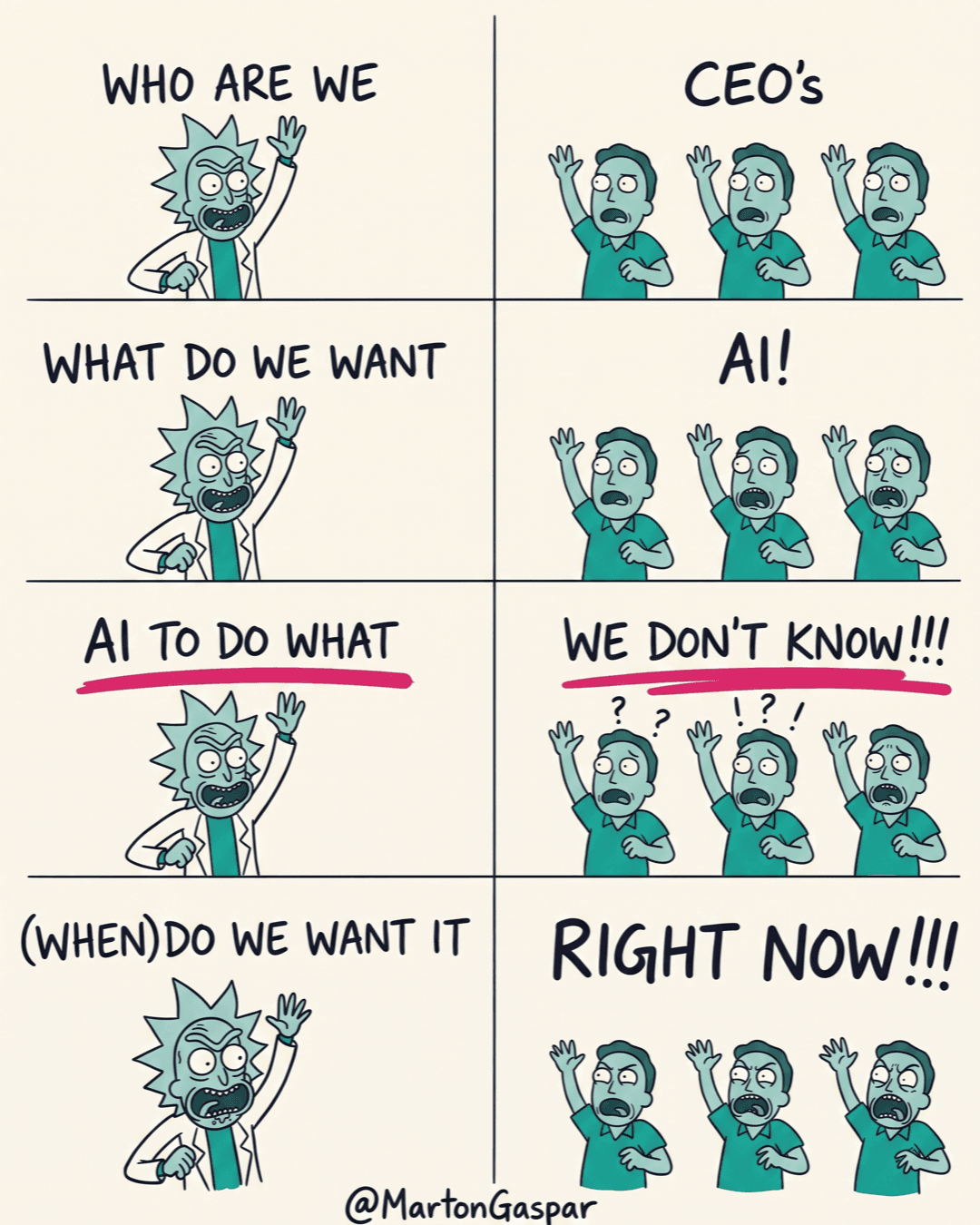
The trap is reading that silence as a lack of intelligence at the top. It isn't. It is a distance problem, and it comes with the seat. The comic that goes with this piece tells the whole story in four panels. Who are we? CEOs. What do we want? AI. AI to do what? We don't know. When do we want it? Right now.
The people demanding AI are furthest from the work
The people demanding AI are the furthest from the work that makes it worth anything. Their seat puts them there.
They read the headline. You watched the user give up.
They feel the board breathing down their neck. You know which small problem is the one killing conversion.
They see a switch to flip. You see a hundred calls that decide whether flipping it creates value, or just expensive noise.
None of that is a knock on the CEO. Their job sits at the top, with the board. Yours is the ground truth underneath it. The better move is to stop waiting for the top to supply the answer, and to bring the answer from where you already stand.
The person closest to the user is the one who can say what the tool is for.
It has the words. You were there.
AI has read the transcript of every customer call you've ever run. It has still never been in the room.
It doesn't live, so it has never lived through anything. It has never sat across from someone who smiled, thanked you, then churned anyway. It has never felt the complaint everyone dismissed turn into the reason you missed the quarter.
A transcript records what was said. Being there tells you what it meant, which parts to believe, and which throwaway line was the real signal. That is judgement, and it comes from contact with the work.
It has the words. You were there. That gap is the job.
Your job moved to the part AI can't copy
Every loud "we need AI" you hear from here is the same thing. It isn't your value disappearing. It's a tool showing up without the one thing that makes it worth anything: someone who knows what to do with it.
The trap is spending your energy defending the tasks the tool now does. The better move is to own the part it can't do. Decide which problem the tool should point at, what good looks like, and how you'll know it worked.
Your job didn't disappear. It moved to the part AI can't copy.
The sentence your CEO can't finish
The product managers sleeping fine tonight can finish the sentence the CEO can't. Here it is, with the blanks left open.
We're using AI to help [who] do [what], so that [what changes], and we'll know it worked when [what moves].
Each blank asks for something only contact with the work can give you. [Who] is a real user or team, not "customers". [What] is a specific task they struggle with today. [What changes] is the difference in their day or in the business. [What moves] is the number or the behaviour you'd watch to know it was worth it.
Try it on the AI idea closest to your roadmap right now. If every blank fills easily, you already hold the answer the room is missing, so bring it to the next meeting before anyone asks. If one blank won't fill, you've found the gap. That's useful to know, and it's far better found by you, on your own terms, than by the next planning meeting.
The sentence is a small test. Filling it is the whole job in one line.
Your CEO can buy AI
The pattern under all of this is simple. Anyone with a budget can buy the tool. Knowing what it is for does not come in the box. It comes from being close enough to users and the numbers to know which problem is the expensive one.
Contact with the work is where a product manager's value has always lived. The CEO's request just makes it easier to see. If the request itself is the problem, the piece When Your CEO Has a Bad Idea walks through how to handle that conversation.
Your CEO can buy AI. What's worth doing with it is your call.
Download the one-page version and pin the fill-in line next to the next AI idea on your roadmap.